
My political journey is quite a bizarre one. If you told my 2014 Social Liberal self that I would later become a far-right Neo Reactionary Propertarian Anarchist, I would laugh at you and think you were lying. But as time goes by human beings have a tendency to change and evolve ideologically. I am no exception. Some of you might be wondering how I managed to go from a center-left Social Liberal to a far-right Anarchist. My full political journey is a story for another day. For now, I want to introduce an ideology I’ve been pondering about for a while now. I’ve considered myself to be a Hoppean Anarcho-Capitalist up until recently. I still consider myself to be “Hoppean adjacent” (meaning that I still sympathize with the ideology). But after during research on the Dark Enlightenment and Anarcho-Monarchism, my political beliefs began to shift ever so slightly. I also still consider myself to be a Free Market Capitalist and Anarchist, but now I’m far more sympathetic towards Absolutist Monarchy. I wanted to see if it was possible to take an unconstitutional Monarchy and make it more voluntary and Individualist. Anarcho-Capitalism showed me how voluntary hierarchies could exist in a Stateless society. The goal of my interpretation of Anarcho-Monarchism is to apply this logic to an Absolutist Monarchist societal structure. This is what made me switch philosophies in the first place. As much as I like what Anarcho-Capitalism has brought to the table in the Libertarian movement, I also prefer societies based around benevolent rulers and wanted a different Stateless social structure where the concept of “Enlightenment Absolutism” is applied to a more Libertarian Panarchist society. All of this sounds ridiculous on the surface, but as I go into detail about my philosophy, things will become more clear. Classical Liberal Auberon Herbert advocated for a voluntarily funded Government entity as opposed to the State. This ideology is known as “Voluntaryism“. Even though Auberon Herbert rejected the word “Anarchy” and wasn’t a Monarchist, his ideology did have an impact on my philosophy. If he were alive today, he would’ve had more in common with Anarcho-Capitalists and Anarcho-Monarchists than any Statist. This is why I consider Voluntaryism to be an Anarchist-compatible philosophy. Any hierarchy without a monopoly on violence is going to be Stateless and inherently Individualist. This is because a purely voluntary hierarchy would respect the existence of competing for stateless social orders for reasons I will get into shortly.
Government vs State: One of the core aspects of Voluntaryism is the distinction between Government vs the State. Statism is when a single hierarchical institution has a monopoly on violence (police and military) services as well as a monopoly on legislation (rule of law) and arbitration (courts and dispute resolution) within a particular territory or nation. What also defines a State is how it’s funded. States are always funded through coercive extortion (involuntary taxation). A governing body could theoretically be voluntarily funded through a “voluntary tax” (non-profit donations) or through other means. A governing hierarchy, for example, could purchase or homestead a piece of private land then allow tenants to rent said land so long as they abide by whatever rules this governing body puts into place on their private property. This is just one example of how a governing body could be funded through voluntary transactions rather than extortion. I’m sure you’re familiar with the term “Taxation is theft” which was popularized by Libertarians and Voluntaryists who noticed that the Government stealing some of your earnings against your will is a form of extortion that violates an individual’s right to own their earnings and spend it as they please. I’m not going to go into this too much since I want to stay on topic. Taxation is theft is also an overused term that doesn’t really need much explanation beyond what I’ve already mentioned. Regardless, if you’re looking for more information relating to this topic go here. The goal of Voluntaryism is to create a Governing hierarchy that is based around voluntary contractual agreements and funded voluntarily. Therefore any Voluntaryist “Government” is not a traditional State. Voluntaryists see Statism and Governance (the process of governing) as separate entities and concepts.
Why Monarchy?: Monarchism leads to lower time preference. Time preference is an important part of human life, within the context of politics it means how much a politician is willing to plan for the future rather than focus on the present. The higher the time preference the less prepared and more rushed their policies will end up being in the long term. Higher time preference is especially common in more democratic representative societies. This is because any parliamentary or presidential-based political system will lead to term limits. Whenever a representative enters office, their time in power is limited(Usually 4-6 years depending on the nation in question). This gives them more of an incentive to just focus on undoing whatever progress their political opponents have made in the past and focusing less on fulfilling campaign promises. A democratic representative is also nothing more than a temporary caretaker of assets they have no ownership over. This is generally a bad thing because if they don’t own the assets then they have no reason to care if those assets are damaged or if their value is ruined or if the asset is misused. Compare this to a Monarchy or Aristocracy where assets are owned by a single private owner (or multiple private owners in Aristocracy). This gives those in power an incentive to care about the economy and how federal assets are used. When the economy grows so does the value of their assets, which makes them wealthier as a result. When federal assets aren’t wasted and are kept in peak condition this saves the owners time and money that they would’ve spent repairing or replacing vital assets like military equipment or infrastructure like border walls. For further context, I recommend watching this Hoppe lecture or going here.
Formalism(Private Governance): Formalism as defined by the Neo-Reactionary blogger Mencius Moldbug is:
“just that the main problem in human affairs is violence. The goal is to design a way for humans to interact, on a planet of remarkably limited size, without violence. Especially organized violence. Next to organized human-on-human violence, a good formalist believes, all other problems—Poverty, Global Warming, Moral Decay, etc., etc., etc.—are basically insignificant. Perhaps once we get rid of violence we can worry a little about Moral Decay, but given that organized violence killed a couple of hundred million people in the last century, whereas Moral Decay gave us “American Idol,” I think the priorities are pretty clear.”
A Formalist Manifesto by Mencius Moldbug (aka Curtis Yarvin)
Moldbug later continues by comparing the United States to a corporation:
“So this is the formalist manifesto: that the US is just a corporation. It is not a mystic trust consigned to us by the generations. It is not the repository of our hopes and fears, the voice of conscience and the avenging sword of justice. It is just an big old company that holds a huge pile of assets, has no clear idea of what it’s trying to do with them, and is thrashing around like a ten-gallon shark in a five-gallon bucket, red ink spouting from each of its bazillion gills.
To a formalist, the way to fix the US is to dispense with the ancient mystical horseradish, the corporate prayers and war chants, figure out who owns this monstrosity, and let them decide what in the heck they are going to do with it.
I don’t think it’s too crazy to say that all options—including restructuring and liquidation—should be on the table.
Whether we’re talking about the US, Baltimore, or your wallet, a formalist is only happy when ownership and control are one and the same. To reformalize, therefore, we need to figure out who has actual power in the US, and assign shares in such a way as to reproduce this distribution as closely as possible.”
A Formalist Manifesto by Mencius Moldbug (aka Curtis Yarvin)
What I agree with in regards to Formalism is the importance of private ownership of assets to reduce violence and craft a society where the ownership of property and control over property become one and the same. Once every piece of public property has a de facto owner it becomes easier to determine who deserves to own and manage the specific property. As an Anarcho-Monarchist, I see this as vital to maintaining a civilized society. A privatized nation makes it easier for individuals to choose who is allowed on their private property and which individuals they want to associate with. What I disagree with is the idea that extortion (taxation) is morally justified just because “it is the entity which owns that territory”. The problem with this argument is that the State has no right to ownership. The State often seizes private land from innocent landowners through lawsuits or Eminent Domain. This is where the contradiction in formalist philosophy starts to appear. You can’t claim that you want a society based around private ownership to reduce violence and make property ownership and control one and the same if the State has the power can literally nationalize whatever private land it wants at any time. My solution in regards to this contradiction is to create my own version of Formalism known as “Post-Formalism“.
Post-Formalism and Post-Libertarians: Post-Formalism’s name is a reference to Post-Libertarianism which is a popular philosophy amongst Neo-Reactionaries. Post-Libertarians believe that preserving individual liberty the implementing law and order is an unconditional good, meaning that the Post-Libertarian fully accept the State as a social institution and as such is no longer aligned with Libertarianism. While not being Libertarian, Post-Libertarianism still adopts a lot of libertarian ideas such as support for free markets, skepticism towards State surveillance of information, and non-interventionism. An example of a Post-Libertarian would be the blogger Nick Land. While I disagree with Post-Libertarians in philosophy I find it very interesting how they adopt libertarian ideals while also rejecting Libertarianism as an ideology. I plan to do something similar with Post-Formalism. Post-Formalists believe that preserving private property rights and individuality through creating societies based around privatized ownership. The purpose of this is to abolish organized violence and reduce confusion and the number of legal disputes amongst individuals. The closer private ownership and control over property becomes, the more individual sovereignty local communities will have which will give them the power to govern themselves. Post-Formalists are either skeptical of State authority or fully reject the State entirely due to its inherent coercive nature to use its monopoly on violence to torment others it doesn’t agree with. This means that Post-Formalism is a private property Anarchist philosophy which makes it disconnected from standard Formalism. The end goal of Post-Formalism is to create a localist Propertarian social order where private governance institutions like Rights Enforcement Agencies and Third-Party Arbitration private firms preserve private property rights, handle legal disputes, and enforce contracts. This sounds a lot like Anarcho-Capitalism, if you think so you are only half-right. Neo-Reactionary Anarcho-Monarchism (Anarcho-NRx) takes the best elements from Hoppean Anarcho-Capitalism and Absolutist Monarchism while ultimately doing its own thing.
Anarcho-NRx vs Anarcho-Capitalism: Now that we’ve explained how the Neo-Reactionary movement has inspired my current ideology it’s about time to explain what makes my new philosophy so different from Anarcho-Capitalism. For starters, we should define what Anarcho Monarchism is. Self-identified “Libertarian Reactionary” Insula Qui does this perfectly in her book “Anarcho Monarchism“. Early into the book, she writes the following regarding what her interpretation of Anarcho Monarchism is:
“Anarchism is the abolition of social hierarchies and an egalitarian social order that eliminates both the State and any other class division. But the poorly named Anarcho-Capitalism emerged from the branch of anglophone Individualist Anarchism. Anarcho-Capitalism simply States that Anarchism, as an existence without the State, is fully possible while retaining hierarchies. This redefinition of Anarchism as an ideology was imprecise and unwarranted, however, due to the popularity of Anarcho-Capitalism, it has not been redefined. When Anarchism can be interpreted as a society without a State, Anarchism can also be interpreted as going alongside any social system, provided that the social system is followed on a voluntary basis. Thus, any social system that does not require a State can be Anarchist. No matter if the social order retains a significant degree of hierarchy, Anarchism can still be realized. This is an absurd way to phrase Anarchism and historically untrue. However, due to the success of Anarcho-Capitalism, there has emerged a radical fringe that has always been on the fringes of various movements. These are people that can call themselves Anarcho-Monarchists without any internal conflict. In this manner, there can be support for an order of Stateless Monarchy, and I happen to be one of the radical fringe who supports both Anarchy and Monarchy. In western thought, this ideal has always been grasped at, but almost never fully embraced. However, with Libertarianism as a movement growing, a lot of people who are inclined to accept the rational arguments of Libertarianism and are also inclined to accept the social reasoning for a Monarchy. These people know how the Monarch, provided he is benevolent, can cause an increase of virtue in society and can guide a society to the right path. These people also know how the State is always inherently destructive and how there is no way to fix the State or to make the State less destructive. Thus these people are willing to embrace the Anarcho-Monarchist doctrine which seemingly is more absurd than the notion of Capitalist Communism or Globalist Nationalism. But the conclusions of Anarcho-Monarchism can easily be reached from a purely principled and ordered approach:
1. All violence against other people is destructive, provided that it is not preventative. As long as there is no self-defence required, violence is inherently a moral, economic and social evil and should be avoided.
2. To prevent violence and conflict in society, there is a need to accept property rights and a need to recognize those property rights universally. Thus, violence is not only an interpersonal issue but an issue between various people over various properties. Violence against property is violence of a different kind, we need to recognize how theft is destructive and how property is owned justly.
3. The only way in which we can own property justly is when that property was not appropriated by violence. This means that the ownership of property requires that it is appropriated from nature (homesteading) or from peaceful trade. Voluntary trade and natural resources are then the only ways in which it is appropriate to gain resources.
4. The State ought to be abolished as the State owns only property due to the unjust appropriation as the property owned by the State can only be owned due to involuntary transfers of money. People are obligated to pay taxes to the State and cannot reasonably revoke their consent, thus the State owns no property rightfully and is an entirely negative institution.”
Anarcho-Monarchism: A Collection of Essays from Insula Qui pages 12-13
As mentioned in the quote above, to maintain a voluntary society, the State MUST BE ABOLISHED. There is no such thing as a voluntary State since everything it owns was gained through coercion in some shape or form. Now that we understand the basics of Anarcho-Monarchism we now need to understand the differences between it and Anarcho-Capitalist principles. As shown by Insula Qui previously, Anarcho-Capitalists have an unnecessary definition of Anarchism. Any society free of unnecessary aggression while also being based around voluntary transactions and doesn’t require Statism to exist is inherently Anarchist, you don’t need to redefine Anarchism to justify your ideology. However, the differences between these two philosophies extend far beyond this. Although both of these ideologies take great inspiration from Auberon Herbert’s Voluntaryism, they’re still drastically different in execution and in concept. Most Anarcho-Capitalists agree with the 4 step approach Insula Qui introduced. Unlike Anarcho-Capitalists, Anarcho-Monarchists take this a few steps further to justify why their ideology is the most efficient. Insula Qui later introduces new steps exclusive to Anarcho-Monarchism in particular:
“5. The abolition of the State cannot solve all problems that people can have in their lives. A society without coercion has no recourse to conflicts that are not predicated on coercion and problems that pertain to personal virtue. Thus, to have an effective Stateless and non-violent society, it can be useful to incorporate governance.
6. The Monarch is the natural head of such a Stateless order. People have a natural tendency towards Monarchy and Autocracy has historically been an effective doctrine of governance. Furthermore, Democracy and centralized Aristocracy cause more social conflict than a singular leader.
7. If we accept the previous assumptions, we are left with the ideal political philosophy that combines Autocratic Governance with Voluntaryism. Thus the King has no right to rule, but the King is accepted as providing a service to the rest of society. Volition is the only basis for the rule of the King and merit is the only reason why this King rules.
Even though in abstraction from these assumptions we can construe that it would be ideal to combine Monarchy with Anarchy, as defined by Rothbard, it may still seem like a vacuous ideal. Reducing a Monarch to what amounts to any other business and creating a government when the state has been abolished can both seem contrary to reason. But the society of the Anarchic Monarchy is completely unlike the state or a business. The Monarch does not demand to be followed, but ultimately most people would choose to follow a Monarch of one sort or another. This is because the Monarchs of the world would demonstrate how effective they are at providing the services of resolving non-violent conflicts and encouraging virtue. Thus the world would be separated into thousands of Kingdoms with each having a Monarch that can cater to the distinct radicals who will appreciate their total freedom without any form of obligation or governance, these people will have to be fully responsible for advancing their own virtue and will have to be fully able to negotiate whenever there are conflicts that do not involve coercion. This is all possible, but very inconvenient. The sort of governance that is possible without the state is only purely benevolent governance, any form of governance that is not worth personally contributing to is not acceptable. This means that there could not be any tyranny, oligarchy or mob rule. The sizes of all these constituencies would also probably be extremely small, most likely never numbering over a few thousand or organized into confederate structures where every semi-independent region is never large. These miniature Governments can fill the productive roles that are currently performed by the large Governments while not employing any coercion or other destructive forces.
The Monarch would not have any inherent right to the money of his people or any territory, but rather would be bestowed dominion and wealth in accordance to how well he functions. Thus, we would have decentralized Monarchies in competition with one another, but not in competition by war as was the Classical standard of Monarchy. This competition would rather be through persuasion and a Monarch would only be able to get a larger Kingdom by providing a better standard of care for his people. The Monarch cannot pursue expansion at the cost to the people who are in his care. The Monarch is faced with the limited extent of his own capacity if he tries to expand beyond that which he personally can handle. This means that each Monarch will have subjects proportionally to his own value to his subjects. In practice, it is likely that people will tend to form Aristocratic or Democratic associations and not purely Monarchic associations.”
Anarcho-Monarchism: A Collection of Essays from Insula Qui pages 15-17
Anarcho-Monarchists like myself also disagree with Anarcho-Capitalists regarding moral code. Unlike Ancaps, I do not believe in the Non-Aggression Principle.
The Flaws of the NAP: Before we critique the Non-Aggression Principle we must first define what the Non-Aggression Principle is. The NAP is best defined as a moral philosophy is based around the idea that all initiation of force is inherently bad and that any form of violence to protect an individual or an individual’s property from an aggressor is justified. How much violence used in self-defense is justified depends on the situation. There are different interpretations of the NAP as well. I’ve seen some Libertarians defend Abortion by arguing that a fetus isn’t a living being. I’ve also seen Libertarians (like me personally) adopt a more “Pro-Life” approach, seeing abortion and nothing more than the murder of an innocent life before they even have a chance to live and choose what lifestyle they want. But who determines what amount of force is justifiable? What even two competing private courts have different ideas of what the NAP is? This is where the Non-Aggression Principle falls flat. It’s too broad, utopian, and open to interpretation to be a viable moral code for an advanced and civilized society. There are also other problems with the NAP. The NAP only applies to humans for reasons mentioned here. This means that disgusting amoral acts like wild animal abuse and bestiality would be perfectly fine and wouldn’t be considered NAP violations. Thankfully, few Libertarians only believe in the NAP and nothing else. Most Libertarians either believe in public courts to handle legal disputes (aka Minarchism) or believe in private sector arbitration as a method of determining when is certain action is justified or unjustified within the confines of a local community.
Dispute Resolution and Private Law: Now it’s time to talk about how private arbitration would work in a Stateless society. The basics of private courts are pretty simple and can be seen here:
A basic explanation of how private courts could function in a Stateless Capitalist society by Gary Baumgardner was taken from this interview. This clip is focused on Anarcho-Capitalism and the age of consent but also applies to Anarcho-Monarchism since both ideologies originate from Individualist Anarchism and Voluntaryism.
As for private law, the Mises Institute has two decent articles regarding the topic:
- Rule of Law without the State: https://mises.org/library/rule-law-without-state
- Feudalism – A System of Private Law: https://mises.org/wire/feudalism-system-private-law
To debunk any arguments regarding corporate monopolies, I recommend watching this video regarding the subject.
You also shouldn’t worry about corporations going rogue as such an outcome is very unlikely for reasons mentioned here:
“Incentives for DROs not to go ‘rogue'” by Bitbutter. This video explains why private security firms are unlikely to go to war in a Voluntaryist society. The term DRO used in the video stands for Dispute Resolution Organization. It’s basically a proposed idea of a private security firm mixed with an insurance company. An Arbitration organization is basically a private court. A link to the original Youtube video can be found here. I recommend supporting Bitbutter if possible.
Don’t expect any Cyberpunk 2077-esque corporate wars happening anytime soon in Ancapistan. This does not mean private corporations are incapable of violence (like the Railroad Wars for example), my argument is simply that these wars would be very rare and would inevitably lead to a compromise between all parties involved. Private corporations are not traditional States, their revenue is not guaranteed through involuntary taxation, and because of this, they can’t afford to fight large-scale battles for very long. Corporate warfare could also lead to consumer casualties making it difficult to sustain a source for continuous profit, especially if a war goes longer than expected. People often over-exaggerate the power of private corporations. Corporations are not perfect, neither are they fully trustworthy at times. This doesn’t mean that Corporations would immediately take over in a stateless society.
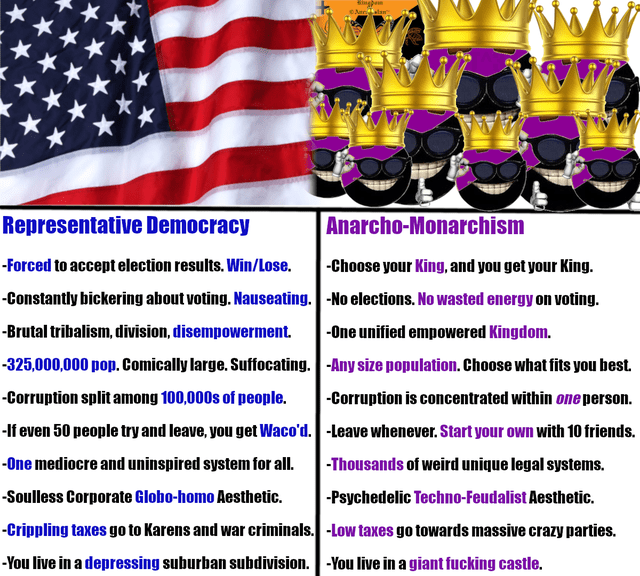
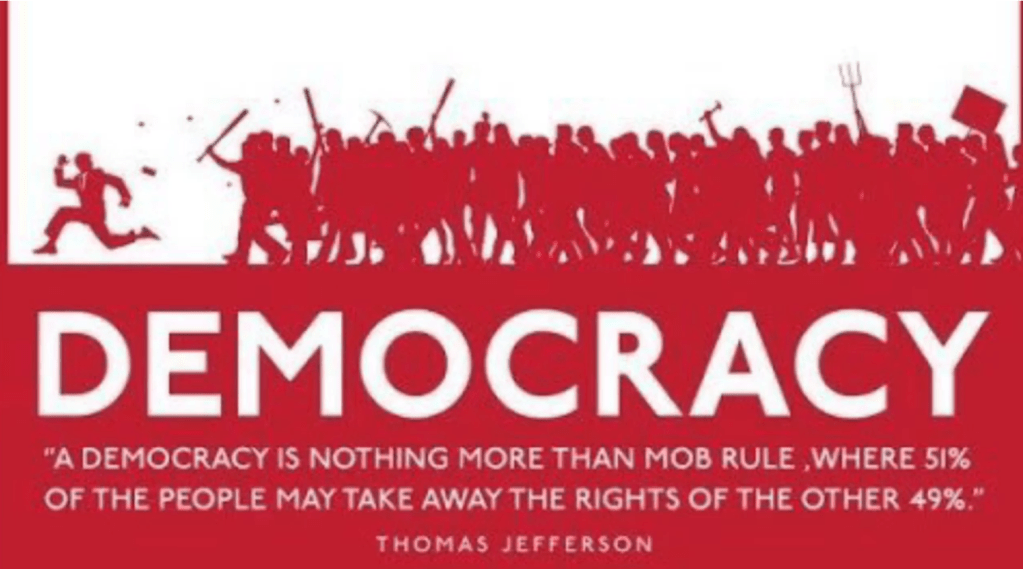
Structure and Hierarchy: An Anarcho-Monarchist society could be structured in many different ways. The Monarch’s role could be to provide voluntary private defense or an Anarcho-Monarch’s job could be very similar to a Homeowner Association’s President. An Anarcho-Monarchy would be primarily funded through contractual monthly fees or other potential services. What separates Anarcho-Monarchism from traditional Statist Monarchies is the fact that Anarcho-Monarchism is based around voluntary association and private contracts rather than unnecessary violence and extortion. You can boycott a crony Monarch like any other private business if you so desire. This level of personal freedom means the real political power is always in the hands of individual private owners. This means that any individual wishing to enter a potential private governance industry that could form in a stateless society would need to respect the interest of their subjects (clients/tenants) or risk bankruptcy or being violently overthrown if they attack their consumer base. Choose your King, form your own Kingdom with friends who agree with you, or you can leave an Anarcho-Monarchist community and choose or create another non-Monarchist social order based on your preferences, so long as it’s voluntary. This means that Anarcho-Monarchism isn’t hostile towards the existence of other Anarchist philosophies so long as they’re voluntary. One of the greatest aspects of Monarchism is how easy it is to destroy if a Monarch goes too far. Democratic societies tend to have much more elected representatives in office as well as a majority vote that sympathizes and voted for said representatives. This makes democratic societies difficult to demolish if the majority vote goes too far and advocates for policies that strip away freedoms from the minority vote. This is why I see democracy as nothing more than mob rule in its purest form.
The Three Estates: The three estates are the main three demographics of the Neo-Reactionary movement. These three main demographics are the Traditionalists(aka Clergy), Technology Capitalists(aka Nobles/Techno-Commercialists), and Ethnonationalists(aka Commoners). I personally identify primarily with the Capitalist estate with some sympathies towards the Traditionalist estate and National identity. All three estates disagree with one another but need to co-operate with one another to bring balance and order to Western Civilization(further context here).
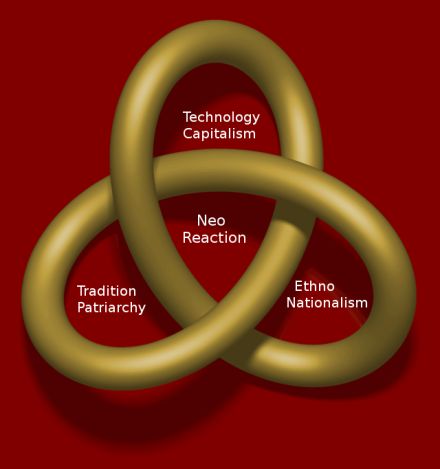
Here’s how these three estates could work together in an Anarcho-Monarchist society:
- The Role of the Traditionalists is to preserve and encourage the practice of tradition through educating and providing care to the youth within the community. The goal is to maintain a consistent social order within the community. A community that’s too inclusive has no identity and will eventually collapse.
- The role of the Capitalists is to produce goods and manage any private business within the general area. These are your CEOs and even the Anarcho-Monarch himself. They keep all the private services and enterprise within the community well organised and productive.
- The role of the Nationalists is the provide defense. In a Stateless society, personal defense will be primarily the responsibility of each individual property owner. The Capitalists could provide assistance in this regard through private security, but the primary means of defense in a Anarcho-Monarchist society would be the Commoners themselves through community crowdfunded militias(further context here). The Commoners also place boundaries within the community through social ostracism and private borders. How ethnocentric or inclusive a community is depends on the community in question as explained by Murray Rothbard in his article “Nations by Consent“:
“The question of open borders, or free immigration, has become an accelerating problem for classical liberals. This is first, because the welfare state increasingly subsidizes immigrants to enter and receive permanent assistance, and second, because cultural boundaries have become increasingly swamped. I began to rethink my views on immigration when, as the Soviet Union collapsed, it became clear that ethnic Russians had been encouraged to flood into Estonia and Latvia in order to destroy the cultures and languages of these peoples. Previously, it had been easy to dismiss as unrealistic Jean Raspail’s anti-immigration novel The Camp of the Saints, in which virtually the entire population of India decides to move, in small boats, into France, and the French, infected by liberal ideology, cannot summon the will to prevent economic and cultural national destruction. As cultural and welfare-state problems have intensified, it became impossible to dismiss Raspail’s concerns any longer. However, on rethinking immigration on the basis of the Anarcho-Capitalist model, it became clear to me that a totally privatized country would not have “open borders” at all. If every piece of land in a country were owned by some person, group, or corporation, this would mean that no immigrant could enter there unless invited to enter and allowed to rent, or purchase, property. A totally privatized country would be as “closed” as the particular inhabitants and property owners desire. It seems clear, then, that the regime of open borders that exists de facto in the U.S. really amounts to a compulsory opening by the central state, the state in charge of all streets and public land areas, and does not genuinely reflect the wishes of the proprietors. Under total privatization, many local conflicts and “externality” problems-not merely the immigration problem-would be neatly settled. With every locale and neighborhood owned by private firms, corporations, or contractual communities, true diversity would reign, in accordance with the preferences of each community. Some neighborhoods would be ethnically or economically diverse, while others would be ethnically or economically homogeneous. Some localities would permit pornography or prostitution or drugs or abortions, others would prohibit any or all of them. The prohibitions would not be state imposed, but would simply be requirements for residence or use of some person’s or community’s land area. While statists who have the itch to impose their values on everyone else would be disappointed, every group or interest would at least have the satisfaction of living in neighborhoods of people who share its values and preferences. While neighborhood ownership would not provide Utopia or a panacea for all conflict, it would at least provide a “second-best” solution that most people might be willing to live with.”
Nations By Consent written by Murray Rothbard
Murray Rothbard was referring to Anarcho-Capitalism but it’s still relevant to Anarcho-Monarchism regardless. As mentioned previously, Anarcho-Monarchism is not Anarcho-Capitalism, both are separate Voluntaryist philosophies with different structures and hierarchies. That doesn’t mean the two ideologies don’t have overlap, as shown throughout the blog. At the end of the day, the main goal of Anarcho-Monarchism is to create a synthesis between Autocracy (Absolutism) and Individualism (Libertarianism) to preserve not only freedom but also societal order and national heritage. Anarcho-Monarchism can be best described as an “alliance” of sorts between Monarchism and Anarchism.
 Stateless Sovereignty
Men your intelectual excellence is overwhelming
LikeLiked by 1 person
I will share with a friends of mine that I’m sure they will really appreciate
LikeLiked by 2 people