Economic Calculation Problem Explained

In recent years support for anti-capitalist rhetoric has drastically increased in popularity amongst younger generations. Some of the most popular anti-capitalist economic systems these days are Socialism and Communism. Both Socialism and Communism can be defined as collective control of the means of production. Where the two ideologies differ is their stance on money and the state. Many Socialists (with the exception being Libertarian Socialists) believe that some form of “dictator of the proletariat” and government-controlled currency is necessary to implement a Socialist utopia. Communists on the other hand claim to despise money and the state and instead propose a society that’s stateless, classless, and free of currency entirely. Despite their differences, both Socialism and Communism lead to similar outcomes. It’s either mob rule or a totalitarian dictatorship. If you want to learn more about why Socialism and Communism lead to the tyranny of the majority or tyranny of the few I recommend watching these two videos by MentisWave before continuing further:

I’m not going to focus on the tyrannical aspects of these planned economy based ideologies. A topic like that isn’t relevant to the REAL issue that these systems suffer from. If the only issue with planned economies is that they were autocratic then I wouldn’t be writing this blog post at the moment. The real issue with far-left ideologies is that they’re completely economically incoherent. A planned economy has ZERO chance of ever competing with a market economy even if the planned economy has access to advanced technology. The reason why planned economies will never replace free markets is because of a concept known as the “Economic Calculation Problem” (Also known as the ECP for short).

ECP Made Simple: The Economic Calculation Problem can be defined inability of a central planner to reallocate resources to where it’s most needed. There’s also another part to the ECP known as the Knowledge Problem (For the sake of simplicity I’m going to abbreviate the Knowledge Problem as KP for short). The difference between the KP and ECP is that the KP is based around the idea that a central planner will have a very difficult time determining where to aquire the dispersed information of people’s wants and needs while the ECP is the idea that even if the central planner had access to said information it still wouldn’t be able to plan the economy due to the lack of a competitive price mechanism. Don’t worry I’ll get back to this later. If you want to learn more about the KP and ECP I recommend watching these two video clips:

This video clip explains the Knowledge Problem that Planned Ecnomies suffer from by using railroad construction as an example. This video clip original comes from the video “What If There Were No Prices” by Learn Liberty.
This is a short video by Shane Killian that explains the basics of the Economic Calculation Problem in a easy to understand matter. The original video can be found here.

Debunking Common Anti-ECP Arguments: Many Leftists have attempted to propose solutions on how to “solve” the ECP. Examples of these supposed solutions include but are not limited to:

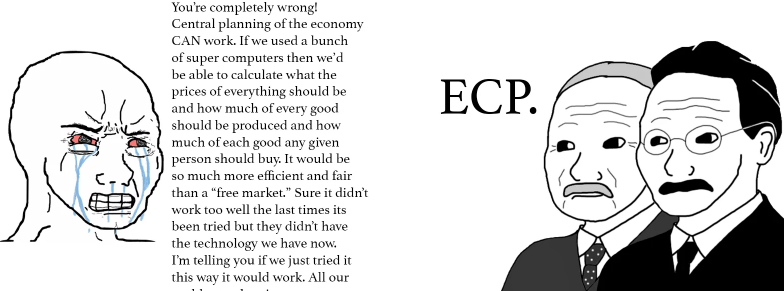
  • “Computers/AI Will Solve The ECP”: The most common proposed solution made by Leftists is the idea that Artificial Intelligence or some sort of hyper advanced computer algorithm will somehow make market economies obsolete. This argument is terrible for multiple reasons. For one, it assumes that the utility of a good or service can be objectively caculated. It also assumes that the utility of different humans can be objectively caculated. It also makes the bold assumption that a computer or AI can somehow track the constantly changing wants and desires of human beings. No such computer or AI has ever shown anything close to achieving this level of calculation. One historical example leftist might try to use is Chile’s abandoned Project CyberSyn. Project CyberSyn was a computer model that would in theory would help Chile with it’s management of it’s state-owned enterprise. It was based on the “Viable System Model” which basically means that it used an advanced computer conceptual model that allows it to supposedly simulate and meet the demands of an ever changing environment in theory. In practice however, CyberSyn struggled to even get off the ground:

“Chile’s Project Cybersyn never had much chance to prove its worth: like Allende himself, it died when the murderous Augusto Pinochet seized power in Chile in 1973. It was probably doomed from the start. As described in Eden Medina’s book Cybernetic Revolutionaries, the sleek control room masked the fact that Allende’s government only owned four computers.”

State-Run Algorithms Should Stay In The Realm of Science Fiction by Tim Harford

As explained by Mr. Hardford, Chile’s CyberSyn project was undeveloped and likely wouldn’t have succeeded despite it’s sleek Star Trek-esque appearance. Even if such an AI algorithm did get built it would still likely fail for reasons highlighted by these video clips:

This video clip is from the 348th episode of the Human Action Podcast titled “Will AI Solve Scarcity?”. I shared this video clip because it makes two important points regarding the ECP and KP. For one it makes the point that you still need a competitve market prices in order to allocate resources to where they’re most needed. The second point this video clip makes is that even if the Central Planning AI becomes feasible, a Capitalist market economy doesn’t need AI to plan everything which gives it a massive advantage over an algocratic Socialist government that always needs to spend a lot of resources maintaining such a powerful hypothetical central planning AI to begin with.
This is a video clip from the Youtube Video titled “Nobody Knows How To Make A Pencil” by LiquidZulu. I included this video clip because it does a good job at explaining in detail how the ability to solve the Economic Calculation Problem has nothing to do with technological factors. Not even the smartest AI Algorithms can solve the ECP. At best the AI could only potentially solve the KP but never the ECP.
  • “Large Corporations Debunk The ECP”: This is argument that’s becoming more popular by leftists who think they understand the private sector but in reality have little to no understanding of what they’re talking about. The origins of this argument come from a book called the “People’s Republic of Walmart”. People who use this argument claim that Walmart and other large enterpises often use a lot of internal economic planning in order to determine where company resources should be allocated therefore any socialist society should be able to accomplish something similar by copying Walmart, right? Wrong. The main problem with this argument is that it conflates ecnomic planning with ecnomic calculation:

“The central error of the book is that it uses two fundamentally
different terms synonymously, economic planning and planned
economy, and views both as incompatible with the market. But one
of them is not only compatible with market economies, but is one
of their foundational tools: economic planning. In order to make a
clearer distinction between the two phrases, they need to be defined
first. Simply put, economic planning is the process by which the
various participants in the economy make calculations about the
economic steps they must take in the future. In contrast, a planned
economy is an entirely centralized system in which the allocation of
everything from raw materials to capital goods, to consumer goods is
implemented by a central authority, without the market mechanism.”

Planned Economy and Economic Planning: What The People’s Republic of Walmart Got Wrong about the Nature of Economic Planning by Márton Kónya page 3

On the surface, it might seem that a planned economy and economic planning only differ in scale. In reality the distinctions between the two become more apparant when you consider factors such as competitve market prices

“In fact, all these previous failures point to the central distinction between economic planning and a planned economy: money prices. If a railway company is in the hands of a private entrepreneur, he has every incentive to choose the method of construction with the lowest monetary costs, assuming the same utility to the consumers (the total income of the project in monetary terms), in order to achieve the highest degree of profit. However, this also serves society best. What does it mean that engineering is too expensive? It means that other participants in the market (for example, farmers) are willing to pay engineers more. The reason for this is most probably that the farmers’ consumers (producers of foodstuffs) are willing to pay them more for their goods (crops). These producers of lower-order goods, in turn, are willing to pay more, because their own customers are willing to pay more for their final goods (foodstuffs). In accordance with the marginalist theory of value elaborated by the founders of the Austrian school, such as Carl Menger ([1871] 2007, 114–65), a change in consumer demand (at whichever stage of production it may occur) creates a signal for producers at higher stages that tells them which needs are to be satisfied more and which less urgently. A rise in the price of engineering means that engineering is being used in production processes that are creating goods which the consumers urgently need, and thus only producers satisfying even more urgent needs may acquire it. The price system, based on the maximization of profit and utility, seemingly coordinates economic participants without any planning. Looking at the big picture, this is certainly true. Yet planning as such not only does not disappear, but is only possible in a free market environment. The Austrian thinkers, such as Hayek (1945), were right in calling the price system a system of information sharing. The price system does nothing more than divide a kind of mental labor between several miniature “planned economies,” mental labor that could not be carried out by a single, publicly owned planned economy. Its tool for this task is money. Money provides the common denominator which the socialist thinkers were unable to invent. It is the tool which enables market participants to use accounting methods to compare the incomes and costs of their activities, and to plan their future steps accordingly (Mises 1949, 230). It is at this level that the important act of economic planning happens. Accounting is how corporations, governmental organizations, nonprofit organizations, the army, the police, the nationalized schools and hospitals, every level of human organization is able to solve its planning problems: via money prices established by the market process based on the private ownership of the means of production. This holds true, of course, only if the preconditions of the formation of a market price are satisfied. In the case of the armed forces, police, and other governmental monopolies, the consumers do not get to decide the price which they would be willing to pay for these services, and as a result prices of production factors employed in these branches (such as policemen’s and soldiers’ wages or the prices of various weaponry) can’t accurately reflect their value relative to other resources, leading to waste. (Later the reason such a monopoly (be it governmental or private) on factors of productions would impede the economic actor’s ability to determine their prices will be explored.) It is fair to say, therefore, that although governmental monopolies can calculate with money prices, their presence in the economy in fact obstructs the economic calculus (on a long-term basis, as opposed to private monopolies, whose errors in calculation are not compensated by taxation).”

Planned Economy and Economic Planning: What The People’s Republic of Walmart Got Wrong about the Nature of Economic Planning by Márton Kónya page 7-8

Basically, the quote above is trying to say that although both centrally planned government organizations and private entities engage in economic planning and the economic calculation of prices, only private entities can use said economic calculation effectively. Consumers in a society with a centralized state with a monopoly over various public services can’t choose how much they’re willing to pay for said government programs. This means whatever production prices the government ends up spending to fund their programs won’t accurately reflect their value compared to other non-government controlled resources, inevitably leading to excessive waste. This means that the public sector can’t just copy what large corporations in the private sector is doing in order to solve the ECP. A more indepth explanation for why this argument doesn’t work can be found in these two videos:

  • “Market Socialism Debunks the ECP”: Some leftists may admit that a traditional socialist economy can’t solve the ECP. Despite this many leftists will still claim that other forms of socialism such as Market Socialism can solve the ECP since they allow some form of market economy to exist. Market Socialism (also known as “Free Market Anti-Capitalism”) is the idea that enterprises should be organized into horizontally structured democratically run businesses known as “Worker Cooperatives”. These businesses would compete with one another in an open market economy just like Capitalism. Unlike Capitalism, Worker Cooperatives would be the only type of business allowed due to private property being abolished. Another major difference between Capitalism and Market Socialism is the fact that Market Socialists support the Marxist Labor Theory of Value rather than the Capitalist Subjective Theory of Value. There are also different types of Market Socialism. Some Market Socialists believe in a centralized government that provides welfare services while others are Anarchists who would believe in mutual aid. These Anarchists variants are known as “Market Anarchism” or “Mutualism”. Regardless of what type of Market Anarchism we’re talking about here, it doesn’t matter in the grand scheme of things. This is because all forms of Market Socialism suffer from similar problems. First problem being the efficiency of Worker Coops (or lack thereof in this case).

The Weakness of Worker Coops: Many leftists like to claim that an collectively owned horizontally structured enterprise governed by direct democracy would be far more efficient and humane compared to it’s private sector counterparts. From their point of view direct democracy gives everyone a chance to have a say in how an enterpise or society as a whole should be run and what policies should be implemented. Doesn’t that sound nice? The problem is that the progressive defense of democracy is antithetical to human nature. For one, democracy doesn’t give everyone a voice. That only applies to the majority vote. But what if a individual disagrees with the majority and wants to determine what’s best for themselves? In a democratic society such indivuduals are disregarded by the masses at best. At worst, they’re being actively persecuted by the majority rule mob for the crime of having a dissenting opinion. This is especially the case when a democractic society has a very large population. The higher the population, the less sway your vote has. This “mob rule” outcome is even more likely to happen in a horizontally structured direct democracy that has no middle man. Atleast in a liberal democracy (both presidential and parliamentary variants) usually have some middle man like the Electoral College or some other institution to prevent the masses from having unchecked control over how society is run. This doesn’t make liberal democracy an ideal system, but it’s atleast more tolerable than other forms of democracy. In a direct democracy however the masses get the final say, making tyranny of the majority all but certain.
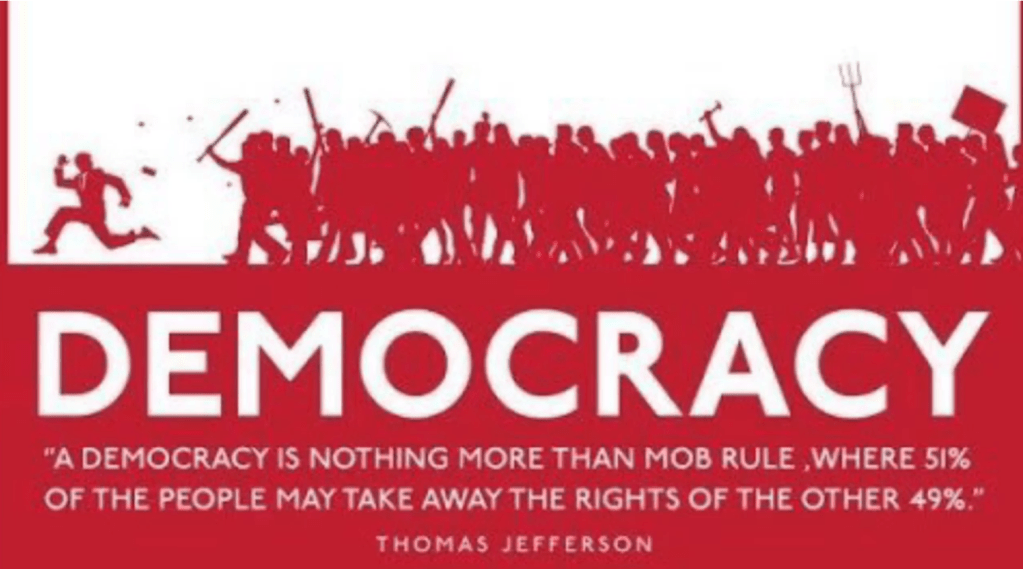
Even if democracy somehow gave everyone a voice it would still suffer from other problems. A common leftist critique of free market capitalism is the idea that “consumers are inheritly irrational beings”. What leftists who use this argument fail to realize is that any critique of consumers also applies to voters even more:

“Here’s the fact: People do a poor job of acquiring information and using it to make decisions in the way that the rational choice model predicts. Here’s the conclusion: This has implications for the capacity of consumers to benefit from markets, because consumers are people. But the conclusion also has to be that voters have the same problem, unless you think people are dumb in the supermarket but miraculously smart in the voting booth. It’s the same person. Why are voters even dumber than consumers? Consider this: A consumer who buys a bad television, or pays too much for a coffee-maker, or gets ripped off on an investment, is stuck with the bad TV, and loses her own money on the coffee-maker or the dumb stock buy. It happens, but you learn from your mistake (this is called “market feedback”) and make a better decision the next time around. Voters, on the other hand, have even less information, have no way of getting accurate information, and know that their choices won’t determine the outcome anyway. If I spend months learning about the candidates, and then cast my vote for president, it has absolutely zero impact on the outcome. Not small, mind you: zero.”

Every Flaw in Consumers Is Worse in Voters by Micheal Munger

Basically what Mr. Munger is saying above is that even if the idea that consumers aren’t very intelligent is true it still doesn’t change the fact that any bad financial decision done by a consumer only really harms themselves in the grand scheme of things. Meanwhile, a voter has zero incentive to care about who they’re voting for because their decision ultimately has no impact regardless of how much research they do before their decision. Even if every vote DID have a substantial impact, voters would still be far worse off than a consumer if they make a mistake. This is because any bad political decision has the potential to destroy the entire country. Meanwhile, any bad personal economic investment will only harm the investors involved. There are also other problems with Worker Cooperatives other than “democracy bad”. Market Anarchists and other leftists in general like to claim that their enterprises are horizontally structured and therefore are less likely to lead to exploitation. This isn’t true because hierarchies still form in different ways even in Coops:

“When an organization touts itself as truly egalitarian, it garners much attention from the press, which itself is a signal of its rarity. So, some companies, such as IDEO and Gore Inc., promote their egalitarian ways as do other types of organizations, such as the chamber orchestra Orpheus, whose primary claim to fame is that it functions without a conductor (Seifter, Economy, & Hackman, 2001). However, closer investagations of these organizations show that, though they have ridden themselves of some of the usual trappings of hierarchy, many hierarchical patterns remain. For example, the product design firm IDEO looks egalitarian from the perspective of formal positions. There are more than 150 employees, and almost everyone carries the formal title of “engineer”. Yet, firsthand observations of brainstorming sessions reveal that the engineers compete for respect and status at face-to-face meetings (Sutton & Hargadon, 1996). Engineers acquire status based on their respective abilities to come up with “cool” ideas at the brainstorming sessions. Status is doled out in the form of compliments (“neat” “wow” or “cool”), by pursuit of one person’s idea by others, and by invitations to further brainstorming meetings. The brainstorming sessions are perceived as a chance for engineers to “strut their stuff” and when invitations to attend are not forthcoming, engineers often see this as a sign that they should leave the organization. Engineers who acquire these status markers also get paid more than those who do not. Thus, although it might look egalitarian on the surface, IDEO is hierarchical: “equal” members do not have equal influence, equal levels of respect from their colleagues, or equal access to resources. Similarly, although the chamber orchestra Orpheus does not have a conductor and began with very few hierarchical levels for an orchestra, a different member is now appointed the “concert master” for each piece of music (Seifter, Economy, & Hackman, 2001). The founder and president has full control over the nature of the program, including what set of pieces are played and what the program looks like, and there is a “core groups” comprised of the “principal”(i.e., highest ranked) string and woodwind players which makes a number of key group decisions. Orpheus is not alone in the drift it has experienced in becoming more hierarchical over time. Newly formed Silicon Valley companies also tend to become more hierarchical over time (Baron & Hannan, 2002). Those who do not evolve toward hierarchy are less likely to survive.”

Organizational Preferences and Their Consequences by Deborah H. Gruenfeld and Larissa Z. Tiedens pages 12-13

As shown by Deborah and Larissa in the quote above, even the most egalitarian enterprises become more hierarchical over time because it increases the chances of the firm’s survival and keeps employees more organized. You know what? Let’s give these “Market Socialists” the benefit of the doubt. Let’s assume all egalitarian enterprises are anti-hierarchal just like how they advertise themselves to the general public. Even if this was the case, it still wouldn’t make horizontally structured firms more efficient or less exploitative than their hierarchical private sector alternatives. For example, there’s a study that shows that Worker Coops are more likely to grow slower and provide fewer jobs than traditional private firms. Wages in Worker’s Coops are also 14% lower on average compared to privately owned companies. This study is ironic because leftists often claim that Capitalists are far more likely to underpay their workers than egalitarian enterprises. High-skilled workers are also more likely to leave such Cooperatives because they see them as a hindrance rather than a benefit. Worker Coops with a large number of employees have lower worker satisfaction than smaller Cooperatives. This debunks the myth that Worker Cooperatives would be better for workers on a large scale. In reality, Worker Coops provide more satisfaction for their employees on a smaller scale. There’s also another study that proves that Coops are no more productive than their private sector counterparts. There’s also an additional study that suggests that workers in employee-owned businesses often abandon Worker Cooperative principles over time. Worker Coops are also highly ineffective at reducing unemployment. These studies show that Worker Coops are less effective at helping the worker class and preventing exploitation than private firms. Don’t get the wrong idea though. I’m not against the idea of Worker Coops being allowed to exist as long as they’re voluntary. The beauty of Capitalism is you have the choice between both types of firms as a worker. Under Market Socialism, on the other hand, you’re stuck with the objectively inferior option. Despite all of this, I’m going to give “Market Socialists” the benefit of the doubt one more time for the sake of an argument. Let’s assume that Leftists are 100% right about Worker Coops being less exploitative than private firms despite all the evidence I provided. Does this make “Market Socialism” a superior system to Capitalism? Even under these hypothetical conditions, the answer is a resounding no. This is because of a concept known as the Property Problem.

The Property Problem Explained: The Property Problem is the idea that without private ownership of the means of production, an entrepreneur is limited in how they can use their resources to their best capabilities. In other words, under Market Socialism there’s no real competition because an centralized regulatory agency always has the final say in what economic plans get implemented. The economist Mateusz Machaj elaborates on this in greater detail:

“The problem of arithmetic is absent in market socialism, so Mises was incorrect, but his critique grows very strong, when it comes to managers’ decisions. The planner sets the level of prices in the socialist economy and decides about the range of planning, but some of the decisions must be transferred into the hands of managers, who act in a similar fashion as the entrepreneurs do in the capitalist system. Lange argued that they could engage in the production process in exactly the same way as entrepreneurs do in the private property system. Their demand will depend on the final consumer demand and their choices will influence the volume of spending on particular factors of production. Cost accounting will easily develop; shortages and surpluses will indicate the correct direction in which centrally administered prices should change. In order to fully grasp the Misesian analysis of the managerial model, it might be helpful to note the essential difference between Mises and Kirzner on this point. Kirzner’s thesis is that the manager can be an entrepreneur. Not only that, but also the question of whether or not this is the case cannot be “decided by a priori reasoning” (Kirzner 1978, p. 72). It seems to be the natural consequence of Kirzner’s statement that the entrepreneur does not need to own any resources. Mises’s idea however openly rejects the thesis that entrepreneurship is possible without resources: The managerial function is always subservient to the entrepreneurial function. It can relieve the entrepreneur of a part of his minor duties; it can never evolve into a substitute for entrepreneurship. This fallacy to the contrary is due to the error confusing the category of entrepreneurship as it is defined in the imaginary construction of functional distribution with conditions in a living and operating market economy. The function of the entrepreneur cannot be separated from the direction of the employment of factors of production for the accomplishment of definite tasks. The entrepreneur controls the factors of production; it is this control that brings him either entrepreneurial profit or loss. (Mises 1966 p. 306; emphasis added)This brilliant insight contradicts Kirzner’s statement that ownership can be separated from entrepreneurial activity. As Mises emphasized, capitalism is an entrepreneurial system—a system based on private property. What defines the entrepreneur is the control of scarce resources in an uncertain world, not “alertness,” but control and ownership. The entrepreneur is not “alert,” he’s “in control.” Alertness is possible under any system, including full socialism, and the analysis in this case can be based on empirical observations, not apriorism. It is entirely different from the problem of controlling the resources; under socialism the control lies in the hands of one agency, and no one else is permitted to act freely within that system. This fact can be recognized by a priori reasoning. In the Misesian framework entrepreneurship is necessarily abolished in the socialist system, but in the Kirznerian framework “entrepreneurship” might function under socialism. Mises criticized the idea of substituting entrepreneurship (private property control) for public management on the grounds that managers can only act within the limits set by the final decision maker. In the capitalist society, managers are bound by the shareholders and the capital owners, who do have the tools to allow them to decide ultimately what happens with the resources. In the case of the socialist economy there is only one ultimate decision maker: a central agency formulating the plan. In other words, managers cannot “play” competition, since in order to act like real entrepreneurs they would have to be fully sovereign in their decisions just as the private property owners are. But they are not, because any “competing” manager is equipped with resources and instructed by the same single owner. As Mises notes: The entrepreneurs and capitalists establish corporations and other firms, enlarge or reduce their size, dissolve them or merge them with other enterprises; they buy and sell the shares and bonds of already existing and of new corporations; they grant, withdraw, and recover credits; in short they perform all those acts the totality of which is called the capital and money market. It is these financial transactions of promoters and speculators that direct production into those channels in which it satisfies the most urgent wants of the consumers in the best possible way. These transactions constitute the market as such. If one eliminates them, one does not preserve any part of the market. What remains is a fragment that cannot exist alone and cannot function as a market. (Mises 1966, p. 708) The entrepreneur must be in full control of the resources he directs. This control allows him to engage in competition with other owners, and this control brings him profits or losses. Capitalists decide what to do with a particular factory—e.g., they can at any time open a pharmacy, dance club, or hospital. They can choose among many different factors of production and the decision about the destination of the resources controlled by them lies in their hands. In the socialist economy it is necessarily absent, since, as we have indicated, socialism is a compulsory creation with one owner deciding about all the resources. Managers are not the ultimate decision makers, and the breadth of their decision-making is a product of one socialist plan imposed by a central agency. It is an illusion and an open contradiction to call that situation competition, since the ”competitive” conditions are a by product of one will acting.”

Market Socialism and the Property Problem: Different Perspective of the Socialist Calculation Debate by Mateusz Machaj pages 5-7

As stated in the quote above. The so-called free market competition under “Market” Socialism is nothing more than an illusion since the decisions of managers are confined within a single socialist plan predetermined by one monopolistic regulatory agency. Even under Market Anarchism a similar problem occurs (albeit to a much lesser extent) even though there’s no state planning the economy. This is because under Market Anarchism, no such private ownership of the means of production seen under Capitalism would be premitted. This prevents entrepreneurs from making economic descisions such as such as estalblishing new firms, growing or shrinking the size of a paticular firm, merging or dissolving firms or any other financial descision without the approval of the majority vote. This results in Market Socialist firms to be more bureaucratic and less efficient because their economic decisisons are being constrained by an majority vote under direct democracy or a dictatorial government agency thus giving Capitalism the ultimate advantage in regards to resource allocation and decision making. In other words, under free market Capitalism entrpreneuers can do far more with their capitol much faster because of their sovereign control over their property which allows them react and coordinate quickly and more effectively to ever changing economic variables and conditions.

In conclusion, no Socialist economic system will ever come close to solving the Economic Calculation Problem, Knowledge Problem, or Property Problem all at once. Capitalism is just more effective at making economic decisions because of its competitive pricing mechanisms and strong private property rights. There are many other arguments against the ECP but I won’t be addressing them here since I’ve already addressed all the major ones here. Perhaps I will consider making a Part 2 sometime later down the line once I have the time for it. For now, I plan on leaving this topic aside for the time being in favor of other political and economic subject matter that interests me personally.
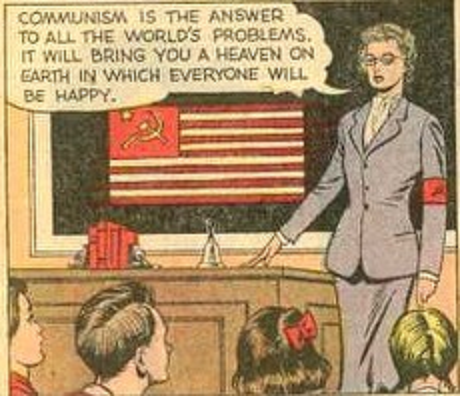
The Origins of Woke Capitol and Moral Decay In Western Civilization

One of the most misunderstood topics amongst the Dissident Right is the topic of “woke corporations”. Many self-identified “right-wingers” (especially those of the “Economic Populist” and “Third Positionist” variety) fail to understand true nature of progressivism and how it spreads. They’re very good at identifying the existence of the problem but are incapable of understanding what incentives led to the origins of the problem in the first place. Many right-wing dissidents will choose to take a page from the Leftist playbook and blame “unfettered capitalism” for the rise of consumerism and social egalitarianism in western countries. While this argument may sound nice on paper, there are several factors that show why this isn’t the case.

Defining Wokeness: Before I explain what causes the current moral decline and political polarization within western countries, we must first define what wokeness even is. Wokeness can be best described as any aggressive political push for egalitarianism usually based on the idea that anything that doesn’t have a equity-based outcome must be the result of bigotry or discrimination. The end result of egalitarianism is what we’re currently seeing in our society today. Anyone who is straight, white, and/or male is considered toxic and privileged because of who they are. No amount of appeasement to those who believe in Wokeness will ever change this. For further information on what Wokeness actually is I’m going to link to a video by the Youtuber MentisWave for further context:

Biological Leninism: The Neo-Reactionary blogger Spandrell defines Biological Leninism as the following:

“So again, the genius of Leninism was in building a ruling class from scratch and making it cohesive by explicitly choosing people from low-status groups, ensuring they would be loyal to the party given they had much to lose. It worked so well it was the marvel of the intellectual classes of the whole world for a hundred years. Meanwhile, what was the West doing? The West, that diehard enemy of worldwide Communism, led by the United States. What has been the American response to Leninism? Look around you. Read Vox. Put on TV. Ok, that’s enough. Who is high status in the West today? Women. Homosexuals. Transexuals. Muslims. Blacks. There’s even movements propping up disabled and fat people. What Progressivism is running is hyper Leninism. Biological Leninism. When Communism took over Russia and China, those were still very poor, semi-traditional societies. Plenty of semi-starved peasants around. So you could run a Leninist party just on class resentments. “Never forget class-struggle”, Mao liked to say. “Never forget you used to be a serf and you’re not one now thanks to me”, he meant. In the West, though, by 1945, when peace and order was enforced by the United States, the economy had improved to the point where class-struggle just didn’t work as a generator of loyalty. Life was good, the proletariat could all afford a car and even vacations. Traditional society was dead, the old status-ladders based on family pedigree and land-based wealth were also dead. The West in 1960 was a wealthy, industrial meritocratic society, where status was based on one’s talent, productivity and natural ability to schmooze oneself into the ruling class. Of course liberal politics kept being a mess. No cohesion in a ruling class which has no good incentive to stick to each other. But of course the incentive is still out there. A cohesive ruling class can monopolize power and extract rents from the whole society forever. The ghost of Lenin is always there. And so the arrow of history kept bending in Lenin’s direction. The West started to build up a Leninist power structure. Not overtly, not as a conscious plan. It just worked that way because the incentives were out there for everyone to see, and so slowly we got it. Biological Leninism. That’s the nature of the Cathedral.

Biological Leninism by Spandrell

Basically what Spandrell is saying here is that Biological Leninism is how progressive ideals gain influence in Western Civilization. Biological Leninism doesn’t spread through traditional coordinated leadership but instead because of incentives created by the inefficiency of Liberal politics. One of the main problems of Liberalism is that it’s divisive democratic political structures lead to abnormally high levels of political polarization and bureaucratic inefficiency compared to the aristocracy that predates it. I’m not going to focus too much on the failures of Liberalism since I want to save that topic for a potential future blogpost but it’s important for us to acknowledge these flaws since this is what allowed Biological Leninism to fester in Western institutions to begin with. People (mainly political elites) are unsatisfied with the current status quo want immediate change. What makes Socialism trendy amongst the downtrodden is that promises high status to those who don’t deserve it. Egalitarians constantly demand that things such as “food” or “healthcare” is somehow a right and must be provided to all as a result. Not only this opinion popular on the left but there are also so called “right-wing” economic populists pushing for this nonsense as well. Little do these pseudo-conservatives realize is that the same economic leftism they’re praising is also a major cause for the rise the excessive hedonism that they claim to oppose.

Negative vs. Positive Rights: A negative right is best understood as “freedom from interference”. It’s the right to do what you like so long as you aren’t harming others or their property. Examples of violations of negative liberty include but aren’t limited to: slavery, extortion, rape, murder, physical abuse, groping, child abuse etc. What all these negative liberty violations have in common is that they involve one individual forcing to another person to either give up something they own or have their body being used and/or hurt in a way that they never consented to. The opposite of negative liberty is positive rights. It’s the idea that people should be obligated to provide for others even if they don’t consent to such an arrangement. The problem with this is pretty obvious. Forcing one individual to provide something of theirs to someone else against their will isn’t all that much different than endorsing slavery. For further information regarding this topic I recommend reading my previous blog post on the Civil Rights Act.

Do Free Markets Cause Moral Decay?: Now that I’ve explained why left-wing economic policy fails from a moral perspective it’s now time to talk about the other elephant in the room: Economic Populism. Economic Populists (also known as Econ Populists for short) is a mainly conservative movement which is attempting to obtain power by appealing to the left. They believe that fiscal conservatism leads to morally bankrupt society and that the only way to fix it is to adopt left-wing economic policies and mix it with socially conservative government policy. The main problem with Econ Populism is that it’s logically incoherent from the get-go. For one, there’s nothing conservative about leftist central planning. The welfare state for example is one of the leading causes behind moral decay:

“The welfare state is a debt state that will no longer be able to pay off the promised benefits to future generations. Due to the above-mentioned incentive structure, more and more payers are being withdrawn from the system while at the same time the number of beneficiaries is growing. In parallel, benefit levels are rising steadily and the social bureaucracy is expanding. This not only increases government spending constantly, but also reduces potential economic growth, because fewer and fewer people are working in the productive sector. However, less economic growth in turn leads to an increase in the number of people in need. A vicious circle has been set in motion. The welfare state is fighting more and more desperately the problems it has caused itself. Pay-as-you-go systems are accelerating the path to financial ruin. Most social “insurances” (pension, illness, unemployment) are based on the pay-as-you-go system, i.e. the amounts paid in are immediately passed out to the beneficiaries. Since the available funds are simply redistributed, nothing is saved, no investment is made and no income is generated. As payers become fewer and fewer, get older and have fewer and fewer children, the system has a serious problem. For decades, the enormous construction-related cost increase of the social systems can therefore only be countered by the constant expansion of public debt. The mass immigration of the unskilled, conceived as a solution, will not solve this problem, but only make it worse. Reforms of the welfare state are either superficial or leave only a slight bend in the steadily rising expenditure curve over the coming 15-20 years. Consequently, the rate of government spending in Western democracies has risen from an average of 12% to almost 50% over the last hundred years. Expenditure attributable to the welfare state already accounts for more than 50% of the state budget in Germany. In the last forty years German national debt has grown from 167 billion to 200 billion euros! If all the pension and social entitlements of the municipalities and federal states are taken into account, the figure is 8,000 billion or 8 trillion euros, respectively. In the business world, a company in a comparable situation would have had to file for bankruptcy due to over-indebtedness. In other Western welfare states, the situation is similar.”

Free Private Cities by Titus Gebel pages 32-33

This quote from the entrepreneur Titus Gebel perfectly explained how welfare states discourage productive financial savings amongst private citizens in favor of government dependency and high debt. This excessive progressive government spending is also known as high time preference behavior. Time preference within the content of politics and economics is how often someone is willing to spend money or implement short sighted political policies now compared to how likely they are to save money or prioritize long-term stability. Welfare spending and other left-wing economic policies always lead to higher time preference in terms of economics and politics due to it leading to political instability and extreme economic debt. Welfare programs also have an overwhelmingly negative effect on birth rates. Women on welfare are less likely to have children leading to the decline of not only birthrates but also western families as a whole. The difference between Econ Populists and Leftists is that Leftists KNOW their policies lead to hedonism and they don’t care. This is what they want after all, so why would they oppose it? This video clip explains all of this in greater detail:

This video clip is from MRHLegacy’s video on “Debunking Every Anti-Capitalist Argument Ever” on YouTube. This video does a great job at explaining why Leftist government economic policy leads to a more hedonistic society that rewards social parasites and punishing low time preference individuals who want to save their wealth for future generations. These progressive economic policies eventually lead to the decline of Western Civilization as a whole. The full video can be found by clicking this link.

Another argument that both Econ Populists and Leftists love to use is the idea that capitalism puts profits over people. People who use this argument claim that the profit incentive dehumanizes people by encouraging businesses to treat their customers more like vessels to suck resources from rather than individuals with their agency, livelihoods, autonomy, and interests. This argument is based on a fundamental misunderstanding of what profit even is. In order to profit financially in a free market economy, you need to provide something that is in consumer demand. In other words, what determines profit is whether or not you’re providing value to society. A business that provides something no one wants won’t make any money because its products and services don’t have any consumer demand. Another problem with this argument is that it assumes that altruism isn’t profit-driven when in reality it is. This because of a concept known as “psychic profit”. The term psychic profit is defined by the Mises Wiki as…

Psychic profit and loss is an increase (profit) or decrease (loss) in the acting man’s satisfaction or happiness. Psychic profits and losses are sensible, subjective, mental and purely personal. They can be neither measured nor weighed. They can only be felt or sensed. The psychic profit or loss derived from any action can be compared with that of another solely in terms of more or less.”

Psychic profit and loss definition from the Mises Wiki

“The cathedral”: If you’ve been paying attention to the Spandrell quote I references previously you’ll notice he mentioned something known as the “cathedral”. The term was originally coined the the reactionary blogger Curtis Yarvin (aka Mencius Moldbug) to describe decentralized “alliance” of progressive media pundits and Marxist academic intellectuals that control the Overton Window of our modern society:

“I notice more people using this label, which I coined a long long time ago, and have always had ambivalent aesthetic feelings about. I used a capital C, but I see more of the miniscule and I think it’s better. “The cathedral” is just a short way to say “journalism plus academia”—in other words, the intellectual institutions at the center of modern society, just as the Church was the intellectual institution at the center of medieval society. The mystery of the cathedral is that all the modern world’s legitimate and prestigious intellectual institutions, even though they have no central organizational connection, behave in many ways as if they were a single organizational structure. Most notably, this pseudo-structure is synoptic: it has one clear doctrine or perspective. It always agrees with itself. Still more puzzlingly, its doctrine is not static; it evolves; this doctrine has a predictable direction of evolution, and the whole structure moves together. For instance: in 2021, Harvard, Yale, the Times and the Post are on the same page. If there exists any doctrinal difference between any two of these prestigious American institutions, it is too ineffable for anyone but a Yale man to discern. (Though it may say something that Gray Mirror is not taught at Harvard.) In 1951, Harvard, Yale, the Times and the Post were on the same page. But Yale in 1951 was on nowhere near the same page as Yale in 2021. If you could teleport either Yale into the other’s time zone, they would see each other as a den of intellectual criminals. So it’s not just that everyone—at least, everyone cool—is on the same page. It’s more like: everyone is reading the same book—at the same speed. No wonder all the peasants are seeing conspiracies in their motherfucking soup. If you saw a group of bright red dots move across the evening sky this way, what would you think they were? Pigeons? Remote-controlled pigeons, illuminated by lasers? Sometimes even Occam is baffled.”

A brief explanation of the cathedral by Curtis Yarvin

Basically what Moldbug is saying here is that the cathedral is not an organization or secret society but rather an network of progressive intellectuals (mainly journalists and academics) that use their media influence to push false doctrines designed to control acceptable opinion and to keep our current managerialist technocratic leadership in power. Despite having no real leadership, pretty much everyone in the cathedral has the same agenda, that being the promotion of internationalist globalist progressivism. I’m personally not going to talk about the cathedral much in this blog post because Yarvin has a habit of making the cathedral structure and motivations overly complicated. For now I recommend watching this other recently uploaded video by MentisWave which does a better job at explaining the cathedral than I can. The reason why I’m mentioning the cathedral is because it plays a major role in the manipulation of the political narratives within western societies:

In conclusion regardless if you agree with my economic policies or not, one thing is undeniable is the origin of “wokeness” within western societies has nothing to do with fiscal conservatism but rather more has to due with the failure of Liberal democracy as a political system and progressive economic policy discouraging investments and savings through bureaucracy while subsidizing “free riders” (those who provide nothing of value to society as a whole). Social Conservatives that appeal to the left in hopes of gaining power will quickly find out about the harsh reality that left-wing economic policy can only bring left-wing results. There is no such thing as “Socially right, economically left”. If you are economically left at all, your policies WILL end up creating a left-wing society whether if you like it or not because of the socially egalitarian incentives that those policies ALWAYS cause.

The Rise of Hoppeanphobia

Hans Hermann Hoppe is by far one of the most controversial individuals in the libertarian movement. This is due to both the left (and the right) misunderstanding his political and economic stances. In order to understand why Hoppe is misunderstood, we must first understand who Hoppe is and why he thinks the way he does.

Brief History: Hans Herman Hoppe was born in West Germany in September 2nd 1949. He later attended the German school Saarland University as an undergraduate student and later got his Ph.D. and Master’s Degree at the Frankfurt-based school of Goethe University. He became a student of the self-identified Marxist Jürgen Habermas. Hoppe was originally very supportive of his mentor but eventually disavowed him due to his “morally bankrupt” Leftist beliefs. This eventually led to him learning about Austrian Economics:

“He began as a prize student of Jürgen Habermas, the famous German philosopher and social theorist. Habermas was, and remains to this day, a committed Marxist. He is the leader of the notorious Frankfurt school. Habermas was very impressed with Hans, and, under the patronage of this eminent Marxist, Hans had every reason to expect a stellar academic career in his native Germany. A problem soon arose, though, one which has had happy results for all those who love liberty. Hans soon came to realize that the leftism and socialism he had grown up with was intellectually barren and morally bankrupt. He discovered on his own the great works of Ludwig von Mises and Murray N. Rothbard.”

A Short History of Man – Progress and Decline by Hans Hermann Hoppe (Introduction by Lew Rockwell) page 9

After learning about free-market economics from Mises and Rothbard, Hoppe would later expand upon the ideas promoted by Mises and Rothbard through his own academic contributions. The works of Hoppe have received a mixed reception amongst the libertarian movement depending on who you ask. Hoppe has simultaneously inspired individuals such as Curtis Yarvin and Stephan Kinsella while also recieving criticism from leftist organizations like UnKoch My Campus and bleeding heart Libertarians such as Nathan Smith. Now that we’ve explained who Hoppe is, it’s now time to talk about his more controversial beliefs.

“Physical Removal”: Hoppe’s stance on freedom of association is by far the most controversial and misunderstood aspect of his book “Democracy: The God That Failed”:

“As soon as mature members of society habitually express acceptance or even advocate egalitarian sentiments, whether in the form of democracy (majority rule) or of communism, it becomes essential that other members, and in particular the natural social elites, be prepared to act decisively and, in the case of continued nonconformity, exclude and ultimately expel these members from society. In a covenant concluded among proprietor and community tenants for the purpose of protecting their private property, no such thing as a right to free (unlimited) speech exists, not even to unlimited speech on one’s own tenant-property. One may say innumerable things and promote almost any idea under the sun, but naturally no one is permitted to advocate ideas contrary to the very purpose of the covenant of preserving and protecting private property, such as democracy and communism. There can be no tolerance toward democrats and communists in a libertarian social order. They will have to be physically separated and expelled from society. Likewise, in a covenant founded for the purpose of protecting family and kin, there can be no tolerance toward those habitually promoting lifestyles incompatible with this goal. They—the advocates of alternative, non-family and kin-centered lifestyles such as, for instance, individual hedonism, parasitism, nature–environment worship, homosexuality, or communism—will have to be physically removed from society, too, if one is to maintain a libertarian order.”

Democracy: The God That Failed by Hans Hermann Hoppe page 218

Most leftists will stop reading here and assume Hoppe is advocating for fascism or whatever buzzword they’re using to demonize him. In reality during an interview with Micheal Malice he makes it very clear that his plans for “physical removal” is much more akin to social ostracism:

Original Full Micheal Malice Hoppe Interview can be found here.

Another issue I have with Hoppe’s “Physcial Removal” quote is that it’s also taken out of context by the right as well. I’ve seen right-wingers claim that Hoppe advocated for an Pinochet-style dictatorship. This is blatantly untrue and highly misleading for the same reasons mentioned above. In order to understand why this occured we must first talk about the “Free Helicopter Memes”.

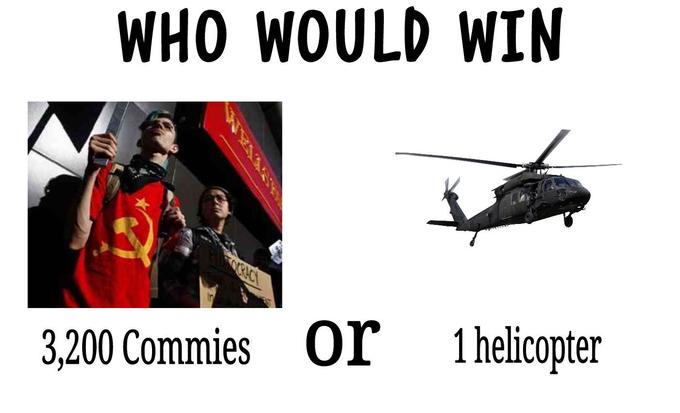
Free Ride, Left Side: During Donald Trump’s 2016 political campaign, various Trump supporters have begun posting memes joking about the murder of Trump’s political enemies through death flights (a form of execution involving throwing the victim out of helicopters) on bulletin boards such as 4chan. Examples of these memes can be seen down bellow:

Eventually these “Free Helicopter Ride” memes began to spread their way into the libertarian movement around 2017-2018 due to the infamous Physical Removal quote mentioned previously. Examples of these memes can be seen down bellow:

Don’t get the wrong idea. I generally like these memes, mainly because it pisses off the right people. It’s better to mock your enemies then allow yourself to become terrified of them. Fear is a sign of weakness, so it’s important for us to avoid showing fear when facing our opponents. At the same time though there are individuals who take the memes too far and unironically advocate for mass genocide of political opponents. Remember that these memes are meant to be political satire aren’t representative of Hoppe’s actual beliefs.

Hoppe On Monarchism: Another misconception about Hoppe that many individuals (mainly on the right) have of Hoppe is his views on Monarchism. Many Neo-Reactionaries like Curtis Yarvin assume that Hoppe’s book “Democracy: The God That Failed” is pro-Monarchism. In reality, Hoppe makes it very clear that he only sees Monarchism as the lesser of two evils when compared to Democracy:

“Despite the comparatively favorable portrait presented of monarchy, I am not a monarchist and the following is not a defense of monarchy. Instead, the position taken toward monarchy is this: If one must have a state, defined as an agency that exercises a compulsory territorial monopoly of ultimate decisionmaking (jurisdiction) and of taxation, then it is economically and ethically advantageous to choose monarchy over democracy.”

Democracy The God That Failed by Hans Hermann Hoppe page XX

Basically, Hoppe’s main objection to Monarchist nation-states is that it’s an institution that supposedly requires a monopoly on the use of force and coercive taxation to fund. What Hoppe fails to realize is that Monarchism doesn’t need force to exist. I’ve already explained why this is the case in my first blog post on Stateless Sovereignty. Despite Hoppe’s opposition to Monarchism, It’s not impossible for Monarchists to take influence from Hoppe’s work. Personally, my favorite part of that book is when Hoppe talks about the time preference of Monarchies compared to Democracies:

“A government is a territorial monopolist of compulsion—an agency which may engage in continual, institutionalized property rights violations and the exploitation—in the form of expropriation, taxation and regulation—of private property owners. Assuming no more than self-interest on the part of government agents, all governments must be expected to make use of this monopoly and exhibit a tendency toward increased exploitation. However, not every form of government can be expected to be equally successful in this endeavor or to go about it in the same way. Rather, in light of elementary economic theory, the conduct of government and the effects of government policy on civil society can be expected to be systematically different, depending on whether the government apparatus is owned privately or publicly. The defining characteristic of private government ownership is that the expropriated resources and the monopoly privilege of future expropriation are individually owned. The appropriated resources are added to the ruler’s private estate and treated as if they were a part of it, and the monopoly privilege of future expropriation is attached as a title to this estate and leads to an instant increase in its present value (‘capitalization’ of monopoly profit). Most importantly, as private owner of the government estate, the ruler is entitled to pass his possessions onto his personal heir; he may sell, rent, or give away part or all of his privileged estate and privately pocket the receipts from the sale or rental; and he may personally employ or dismiss every administrator and employee of his estate. In contrast, with a publicly owned government the control over the government apparatus lies in the hands of a trustee, or caretaker. The caretaker may use the apparatus to his personal advantage, but he does not own it. He cannot sell government resources and privately pocket the receipts, nor can he pass government possessions onto his personal heir. He owns the current use of government resources, but not their capital value. Moreover, while entrance into the position of a private owner of government is restricted by the owner’s personal discretion, entrance into the position of a caretaker–ruler is open. Anyone, in principle, can become the government’s caretaker. From these assumptions two central, interrelated predictions can be deduced:

(1) A private government owner will tend to have a systematically longer planning horizon, i.e., his degree of time preference will be lower, and accordingly, his degree of economic exploitation will tend to be less than that of a government caretaker; and

(2), subject to a higher degree of exploitation the nongovernmental public will also be comparatively more present-oriented under a system of publicly-owned government than under a regime of private government ownership.

A private government owner will predictably try to maximize his total wealth; i.e., the present value of his estate and his current income. He will not want to increase his current income at the expense of a more than proportional drop in the present value of his assets, and because acts of current income acquisition invariably have repercussions on present asset values (reflecting the value of all future—expected—asset earnings discounted by the rate of time preference), private ownership in and of itself leads to economic calculation and thus promotes farsightedness. In the case of the private ownership of government, this implies a distinct moderation with respect to the ruler’s incentive to exploit his monopoly privilege of expropriation, for acts of expropriation are by their nature parasitic upon prior acts of production on the part of the nongovernmental public. Where nothing has first been produced, nothing can be expropriated; and where everything is expropriated, all future production will come to a shrieking halt. Accordingly, a private government owner will want to avoid exploiting his subjects so heavily, for instance, as to reduce his future earnings potential to such an extent that the present value of his estate actually falls. Instead, in order to preserve or possibly even enhance the value of his personal property, he will systematically restrain himself in his exploitation policies. For the lower the degree of exploitation, the more productive the subject population will be; and the more productive the population, the higher will be the value of the ruler’s parasitic monopoly of expropriation. He will use his monopolistic privilege, of course. He will not not exploit. But as the government’s private owner, it is in his interest to draw parasitically on a growing, increasingly productive and prosperous nongovernment economy as this would effortlessly also increase his own wealth and prosperity—and the degree of exploitation thus would tend to be low.”

Democracy: The God That Failed by Hans Hermann Hoppe page 45-47

Basically what Hoppe is saying here is that the owners of “private governments” (aka Monarchies and Aristocracies) have a strong incentive to lower exploitation and taxation in order to maximize their wealth and make sure they have something to pass off to their heir before they die. This is all due to their naturally lower time preference. Time preference within the context of politics is how much a individual cares about the present compared to the future. An individual with lower time preference is far more likely to care about long term success over short term gains. The opposite is the case for high time preference individuals. Monarchies and Aristocracies have lower time preference due to their lack of term limits.

The vast majority of Monarchies and Aristocracies throughout history have allowed their rulers to remain in power until they died. After death, their assets would be given to a heir (successor) that the monarch or aristocrat chosen before death. If a individual of royality had no heir then their assets would be given to a new royal family or someone else genetically related to the original Aristocrat or Monarch in question. This is why Monarchies tend to have lower time preference. It’s because they have too much to lose compared to democratic representatives.

Democratic representatives on the other hand, care very little about long term success due to the lack of incentives to due so. A democratic caretaker doesn’t own a government assets and thus doesn’t have to worry about wasting or damaging government infastructure and resources. Democratic governments also have strict term limits. This means a representative can only remain in office for so long. This may seem like a good thing since it allows people to “vote out” bad leaders during elections. But in reality such a policy only further increases the time preference of the representatives. Because of their limited time in office, elected representatives only really focus on undoing whatever polticial progress their enemies have made while they were in office rather than fufilling campaign promises or maintaining government and economic stability. Although Hoppe isn’t a Monarchist, his critiques of modern Democracy is still something Monarchists can take ideas from.

Hoppe The “Marxist”: Another thing regime libertarians get wrong about Hoppe is when he tried to mix Marxist historical analysis with Austrian econonomics. Until recently most lolberts (regime libtertarians/libertines) would only accuse Hoppe of fascism (something that I debunked earlier) and call it a day. That is until Hoppe’s old work on Marxism came into light again in the libertarian movement. Now Hoppe went from being slandered as a “closeted fascist” to a “blatant communist” in less than a year. In order to understand why this happenend in such little time we need to look at Hoppe’s analysis of Marxism:

“The gradual abolition of feudal and absolutist rule and the rise of increasingly capitalist societies in Western Europe and the United States-accompanied by unheard of economic growth and increasing population-was the result of a growing class consciousness among the exploited, who were ideologically molded together through the doctrines of natural rights and liberalism. In this Austrians and Marxists agree. They disagree, however, as to whether the reversal of this liberalization process and the steadily increased levels of exploitation in these societies since the last third of the nineteenth century, and particularly pronounced since World War I, are the result of a loss in class consciousness. In fact, in the Austrian view Marxism must accept much of the blame for this development
by misdirecting attention from the correct exploitation model of the homesteader producer-saver-contractor versus the non-homesteader-producer-saver-contractor to the fallacious model of the wage earner versus the capitalist, thus muddling
things up.” The establishment of a ruling class over an exploited one many times its size by coercion and the manipulation of public opinion, i.e., a low degree of class consciousness among the exploited, finds its most basic institutional expression
in the creation of a system of public law superimposed on private law. The ruling class sets itself apart and protects its position as a ruling class by adopting a constitution for their firm’s operations. On the one hand, by formalizing the internal operations within the state apparatus as well as its relations with the exploited population, a constitution creates some degree of legal stability. The more familiar and popular private law notions are incorporated into constitutional and public law, the more favorably disposed will be the public to the existence of the state. On the other hand, any constitution and public law also formalizes the immune status of the ruling class as regards the homesteading principle. It formalizes the right of the state’s representatives to engage in non-productive and non-contractual
property acquisitions and the ultimate subordination of private to public law. Class justice, i.e., one set of laws for the rulers and another for the ruled, comes to bear in this dualism of public and private law and in the domination and infiltration of public law over and into private law. It is not because private property rights are recognized by law, as Marxists think, that class justice is established.
Rather, class justice comes into being precisely whenever a legal distinction exists between a class of persons acting under and being protected by public law and another class acting under and being protected instead by some subordinate private law. More specifically then, the basic proposition of the Marxist theory of the state in particular is false. The state is not exploitative because it protects the capitalists’ property rights, but because it itself is exempt from the restriction of having to acquire property productively and contractually. In spite of this fundamental misconception, however, Marxism, because it correctly interprets the state as exploitative (unlike, for example, the public choice
school, which sees it as normal firm among others),” is on to some important insights regarding the logic of state operations. For one thing, it recognizes the strategic function of redistributionist state policies. As an exploitative firm, the state must at all times be interested in a low degree of class consciousness among the ruled. The redistribution of property and income is the state’s means by which it can create divisiveness among the public and destroy the formation of a unifying class consciousness among the exploited. Furthermore, the redistribution of state power itself through democratizing the state constitution and opening up every ruling position to everyone and granting everyone the right to participate
in the determination of state personnel and policy is actually a means for reducing the resistance against exploitation as such. Secondly, the state is indeed, as Marxists see it, the great center of ideological propaganda and mystification: Exploitation is really freedom; taxes are really voluntary contributions; noncontractual relations are really “conceptually” contractual ones; no one is ruled
by anyone but we all rule ourselves; without the state neither law nor security would exist; and the poor would perish, etc. All of this is part of the ideological superstructure designed to legitimize an underlying basis of economic exploitation. And finally, Marxists are also correct in noticing the close association between the state and business, especially the banking elite-even though their
explanation for it is faulty. The reason is not that the bourgeois establishment sees and supports the state as the guarantor of private property rights and contractualism. On the contrary, the establishment correctly perceives the state as the very antithesis to private property that it is and takes a close interest in it
for this reason. The more successful a business, the larger the potential danger of governmental exploitation, but the larger also the potential gains that can be achieved if it can come under government’s special protection and is exempt from
the full weight of capitalist competition. This is why the business establishment is interested in the state and its infiltration. The ruling elite in turn is interested in close cooperation with the business establishment because of its fmancial powers.
In particular, the banking elite is of interest because as an exploitative firm the state naturally wishes to possess complete autonomy for counterfeiting. By offering
to cut the banking elite in on its own counterfeiting machinations and allowing them to counterfeit in addition to its own counterfeited notes under a regime of fractional reserve banking, the state can easily reach this goal and establish a system of state monopolized money and cartelied banking controlled by the central
bank. And through this direct counterfeiting connection with the banking system and by extension the banks’ major clients, the ruling class in fact extends far beyond the state apparatus to the very nerve centers of civil society-not that much different, at least in appearance, from the picture that Marxists like to paint of the cooperation between banking, business elites, and the state.”Competition within the ruling class and among different ruling classes brings about a tendency toward increasing concentration. Marxism is right in this. However, its faulty theory of exploitation again leads it to locate the cause for this tendency in the wrong place.

Marxist and Austrian Class Analysis by Hans Hermann Hoppe pages 7-9

Notice how no where in this quote (or the full article) does Hoppe claim that Marxism is a good ideology. He supports Marx’s historical analysis for the most part while also condemning his theory on exploitation and other fallacies promoted by him. The fact that Lolberts are claiming Hoppe is a Marxist for anazlying Marxism for what it really is shows us that none of these morons actually read the article in question. All Hoppe is doing is highlighting the Pros and Cons of Marxism. Calling him a “Marxist” for this makes no damn sense.

In conclusion, Hans Hermann Hoppe was an incredibly influencial individual in the libertarian movement. His knowledge of Austrian economics and History helped inspire many people. As the years go by it becomes more and more obvious that the real enemy to the liberty movement isn’t Hoppe or his Hoppean supporters but instead it’s the libertines. These libertines care less about preserving consistent methodological values or social order and care more preserving their hedonistic and degenerate lifestyles. It’s time to crush the Lolbert Mob once and for all.

Naming the enemy: Globalist American Empire vs Zionist Occupied Government vs New World Order

Around 2020, people began to use the term “Globalist American Empire” (GAE) — which was popularized by Darren J. Beattie of Revolver News — in place of terms like “Zionist Occupied Government” (ZOG, with “Zionist” being an obtuse way of saying “Jewish Nationalist”). Understandably, some nationalists may prefer the term GAE over ZOG, especially for […]

Naming the enemy: Globalist American Empire vs Zionist Occupied Government vs New World Order

Alt-Right and Identitarian links to Aleksandr Dugin [TL;DR version]

Since the remnant Alt-Right is currently shilling hard for Russia invading Ukraine, as if Putin is some sort of savior, I think it’s a good time to repost this article. Contents TL;DR “Duginism” explained in two minutes1.1. Who is Aleksandr Dugin?1.2. What is “Duginism”?1.3. Why should you care about Duginism? Introduction Who is Aleksandr Dugin?3.1. […]

Alt-Right and Identitarian links to Aleksandr Dugin [TL;DR version]

Naming the enemy: Globalist American Empire vs Zionist Occupied Government vs New World Order

thuletide's avatarThuletide

Around 2020, people began to use the term “Globalist American Empire” (GAE) — which was popularized by Darren J. Beattie of Revolver News — in place of terms like “Zionist Occupied Government” (ZOG, with “Zionist” being an obtuse way of saying “Jewish Nationalist”). Understandably, some nationalists may prefer the term GAE over ZOG, especially for optics purposes, since the latter can carry skinhead connotations due to its explicit anti-Semitism. Being politically associated with people who look like this is not strategically advantageous, to say the least:

It’s the Right-Wing equivalent of Leftists trying to win over the proletariat while looking and behaving like this:

The problem is that “optics friendly” alternatives to “ZOG” have existed for a long, long time. See, for example, Globalism / Globalists, the New World Order, or GloboHomo (Globalism + Homosexuality / Homogenization).

The flaws of using “Globalist American Empire” may not be immediately obvious to…

View original post 818 more words

The Problem With “Idea Ownership”

The topic of Intellectual Property is a very touchy topic for many people. Artists and Inventors especially are the most defensive of Idea Ownership more than anyone else. When you look at the topic of IP (Intellectual Property) from the perspective of a content creator, It makes sense why some would feel the need to be defensive of it. From their perspective, IP is a necessary evil to prevent people from re-uploading or making a copy of other people’s original work without their consent. It seems like a perfectly reasonable defense of IP until you start asking tougher questions. Who determines what is original? Isn’t all art derivative from reality? Why is an artist obligated to exclusive monopoly over their work? What if there’s a competitor that can offer something better than the original creator? Shouldn’t said competitor be able to create another version of an established invention or artwork if they have an idea on how to improve it? These are just some of the moral problems that come with IP ownership. In this blog post, I’ll explain why a world without IP wouldn’t be as scary as most people think it is. In fact, I would argue a world without IP would empower smaller artists, lead to more competition, lower political polarization, make healthcare more affordable, and radically improve artist compensation. Before I explain why IP abolition would objectively make our society better in nearly every aspect, we must first explain how IP even works and how IP is defined.

The Different Types of IP: Intellectual Property comes in various forms depending on what country you live in and what laws are in said country. For the sake of simplicity, I’m going to focus on American IP laws since I live there at the time of writing this. My critiques and analysis of IP also apply to other countries as well. The types of IP include:

  1. Copyright – Copyright is the most well-known form of IP. Stephen Kinsella defines this form of IP as the following:

“Copyright is a right given to authors of “original works,” such as books, articles, movies, and computer programs. Copyright gives the exclusive right to reproduce the work, prepare derivative works, or to perform or present the work publicly. Copyrights protect only the form or expression of ideas, not the underlying ideas themselves. While a copyright may be registered to obtain legal advantages, a copyright need not be registered to exist. Rather, a copyright comes into existence automatically the moment the work is “fixed” in a “tangible medium of expression,” and lasts for the life of the author plus seventy years, or for a total of ninety-five years in cases in which the employer owns the copyright.

Against Intellectual Property by Stephan Kinsella page 10
  1. Patents – Patents are another form of Intellectual Property commonly used for inventions such as original AI algorithms, modern medicine, and machinery. Kinsella defines Patents in further detail as the following:

“A patent is a property right in inventions, that is, in devices or processes that perform a “useful” function. A new or improved mousetrap is an example of a type of device which may be patented. A patent effectively grants the inventor a limited monopoly on the manufacture, use, or sale of the invention. However, a patent actually only grants to the patentee the right to exclude (i.e., to prevent others from practicing the patented invention); it does not actually grant to the patentee the right to use the patented invention. Not every innovation or discovery is patentable. The U.S. Supreme Court has, for example, identified three categories of subject matter that are unpatentable, namely “laws of nature, natural phenomena, and abstract ideas.” Reducing abstract ideas to some type of “practical application,” i.e., “a useful, concrete and tangible result,” is patentable, however. U.S. patents, since June 8, 1995, last from the date of issuance until twenty years from the original filing date of the patent application (the previous term was seventeen years from date of issue).”

Against Intellectual Property by Stephan Kinsella pages 10-11
  1. Trade Secrets – Another common form of IP is Trade Secrets. Trade Secrets are by far the least egregious form of IP. Kinsella explains what trade secrets are in his book:

“A trade secret consists of any confidential formula, device, or piece of information which gives its holder a competitive advantage so long as it remains secret. An example would be the formula for Coca-Cola®. Trade secrets can include information that is not novel enough to be subject to patent protection, or not original enough to be protected by copyright (e.g., a database of seismic data or customer lists). Trade secret laws are used to prevent “misappropriations” of the trade secret, or to award damages for such misappropriations. Trade secrets are protected under state law, although recent federal law has been enacted to prevent theft of trade secrets. Trade secret protection is obtained by declaring that the details of a subject are secret. The trade secret theoretically may last indefinitely, although disclosure, reverse-engineering, or independent invention may destroy it. Trade secrets can protect secret information and processes, e.g., compilations of data and maps not protectable by copyright, and can also be used to protect software source code not disclosed and not otherwise protectable by patent. One disadvantage of relying on trade secret protection is that a competitor who independently invents the subject of another’s trade secret can obtain a patent on the device or process and actually prevent the original inventor (the trade secret holder) from using the invention.”

Against Intellectual Property by Stephan Kinsella pages 11-12

The reason why Trade Secrets are less terrible than other forms of IP like Patents is that they’re enforced by private contract rather than coercive government action:

“Trade secrets are easier to justify than patent or copyright. Palmer argues that they “emerge” from common law-type rights, and are, thus, legitimate. Trade secret law allows damages to be obtained for, or an injunction to be issued to prevent, acts of “misappropriation” of a trade secret. This can be applied against the person who has improperly acquired the trade secret or who divulges the secret contrary to a contractual obligation, and also against others who know that they are obtaining the secret from such a person. Suppose employee A of company X has access to X’s trade secrets, such as its secret formula for a soft drink. He is subject to an employment agreement obligating him to keep this formula secret. He then jumps to X’s competitor, Y. Y wants to use the formula it learns from A to compete with X. Under current law, so long as the secret formula has not been made public, X can get a court order to stop A from revealing the secret to Y. If A has already revealed the secret to Y, X can also get an injunction to stop Y from using or publicizing the formula. Clearly, the injunction and damages against A are proper because A is in violation of his contract with X. More questionable is the injunction against Y, because Y had no contract with X. In the context in which such situations usually arise, however, where the competitor Y wants the trade secret and knows the defecting employee is in breach of contract, it could be argued that the competitor Y is acting in conspiracy with or as an accomplice of employee A to violate the (contractual) rights of trade secret holder X. This is because A has not actually breached his trade secrecy agreement until he reveals trade secrets to Y. If Y actively solicits A to do this, then Y is an accomplice or co-conspirator in the violation of X’s rights. Thus, just as the driver of the getaway car in a bank robbery, or the mafia boss who orders an assassination, are properly held liable for acts of aggression committed by others with whom they conspire, third parties can, in narrowly defined cases, be prevented from using a trade secret obtained from the trade secret thief.”

Against Intellectual Property by Stephan Kinsella pages 56-58
  1. Trademarks – The final type of IP that’s commonly used in western nations is Trademarks. Kinsella defines Trademarks as:

A trademark is a word, phrase, symbol, or design used to identify the source of goods or services sold, and to distinguish them from the goods or services of others. For example, the Coca-Cola mark and the design that appears on their soft drink cans identifies them as products of that company, distinguishing them from competitors such as Pepsi®. Trademark law primarily prevents competitors from “infringing” upon the trademark, i.e., using “confusingly similar” marks to identify their own goods and services. Unlike copyrights and patents, trademark rights can last indefinitely if the owner continues to use the mark. The term of a federal trademark registration lasts ten years, with ten-year renewal terms being available. Other rights related to trademark protection include rights against trademark dilution, certain forms of cybersquatting, and various “unfair competition” claims. IP also includes recent legal innovations, such as the mask work protection available for semiconductor integrated circuit (IC) designs, the sui generis protection, similar to copyright, for boat hull designs, and the proposed sui generis right in databases, or collections of information. In the United States, federal law almost exclusively governs copyrights and patents, since the Constitution grants Congress the power “to promote the progress of science and useful arts.” Despite the federal source of patents and copyrights, various related aspects, such as ownership of patents, are based on state law, which nevertheless tend to be fairly uniform from state to state. Federal trademarks, by contrast, not being explicitly authorized in the Constitution, are based on the interstate commerce clause and thus only covers marks for goods and services in interstate commerce. State trademarks still exist since they have not been completely preempted by federal law, but federal marks tend to be more commercially important and powerful. Trade secrets are generally protected under state, not federal, law.

Against Intellectual Property by Stephan Kinsella pages 12-14

Now that we’ve explained what IP even is, it’s now to talk about why IP isn’t a legitimate form of property.

Why You Can’t Own Ideas: The main problem with the concept of idea ownership is the fact that it contradicts the very purpose of ownership in the first place: scarcity. When you compare ideas to real-world property the two aren’t comparable in the slightest. For example, let’s say you have a car that you worked really hard to get and I decide to steal the car for myself. That’s obviously theft because I deprived you of a scarce good you obtained voluntarily through hard work and voluntary transactions. This is why property rights exist in the real world. It allows us to determine who owns what so that violence and legal disputes can be reduced. Property ownership derives from self-ownership. You are the rightful owner of your own body. To imply otherwise would be an endorsement of slavery. If you don’t own yourself, what’s stopping others from claiming ownership over you? To reject self-ownership would be the equivalent of rejecting your right to autonomy. Therefore self-ownership is important to maintaining autonomy over oneself.

But what does any of this have to do with property ownership? The answer is pretty simple. You own yourself therefore you have the right to own property. Property ownership is a byproduct of self-ownership. But this logic can’t be applied to ideas. This is because ideas have zero scarcity. An idea can be copied one time or one billion times and it wouldn’t make the concept any more or any less scarce. This makes “Idea Ownership” a contradictory term.

“What About The Artists?”: Another common defense of IP is the false idea that IP is a “necessary evil” to allow artists and inventors to receive compensation for their hard work. There are two main problems with this argument:

  1. Just because an artist or inventor makes something doesn’t mean they’re obligated to compensation. If no one wants to buy the invention or artwork then the creator of said original work doesn’t deserve anything. Value is based on the subjective interest of consumers, not based on how much work an artist or inventor puts into something. If there’s no demand, then there’s no value.
  2. There’s no evidence that IP regulation is necessary for preventing the loss of sales of original artwork. If anything there’s evidence of the opposite. For example, the Game of Thrones is the most-watched TV series of all time back in 2019. This made HBO a lot of money. Game of Thrones is also famous for being the most pirated TV series of all time. This proves that IP is useless at protecting artists from people re-uploading their work. It also proves that Piracy alone doesn’t lead to financial losses.

The usual pro-IP counter-argument to these facts usually goes something like “Ok so IP doesn’t work that well. So what? Re-uploading other people’s artwork is still immoral so IP should still exist as legislation to punish pirates who steal other people’s work”. There’s a problem with this argument. The problem is that it assumes that piracy is somehow similar to real-world theft(which it isn’t). If you still aren’t convinced that copying ideas isn’t theft I recommend checking out this song:

This song is called “Copying Is Not Theft” made by the team behind QuestionCopyright.org. The original song can be found here on Youtube. I’m simply re-uploading the song here to make it easy to watch and for archival purposes.

How To Profit In A World Without IP: Another argument I get regarding IP is how will artists be able to profit in a world without IP regulation? If IP doesn’t do anything against piracy then how would a world without IP be any better? I’m going to let the book “Against Intellectual Monopoly” answer that question:

“When an innovator comes up with an idea for a new product he makes copies of it to sell, and those copies are his property in the same way his socks are. The sale of ideas is all about copies – it is only copies of ideas that can be sold. I am even less able to sell “my idea” than to sell myself. In the presence of patents, when an inventor sells the exclusive rights to an idea what is being traded is a copy of the idea plus the right (acquired by the buyer) to now prevent the original inventor from using her idea. Alternatively, when an inventor licenses the use of his idea, what is being sold are just copies of the idea, while the right of telling owners of such copies what to do with them remains with the original inventor. I either sell objects containing copies of my idea–books, CDs, how-to-do-it manuals, trousers with a low cut, multi-purpose gadgets, etc. –or teach my idea to other people directly, and charge for that. Either way, I am selling copies of my idea. In the first case the copies are contained in the objects, in the second case the copies are contained in the minds of the people I have taught. When I write a book and publish one hundred thousand copies, it is one hundred thousand copies of my idea that I am trying to sell. Once I willingly sell a copy of my idea to you, for example a copy of this marvelous book, you become the owner of that copy and I retain my idea together with all the other copies I have printed and not yet sold. In the absence of “intellectual property” you can do what you want with your copy of my idea – the book you purchased from me – in the same way you can do what you want with the ice grinder you bought yesterday from someone else. Without “intellectual property” there is something you can do that you cannot legally do in the world we currently live in: you can spend your time and your resources to make new copies of the book you purchased. If you were to change the title or the name of the author or engage in some other fraudulent deception, that would be plagiarism – which we are not in favor of. But if you change the cover, the quality of the paper, the fonts, the chain of distribution, or the media carrying the original text in a straightforward fashion – or even modify the text with a clear acknowledgment of the original contribution – in the absence of copyright, no property right would be violated. Obviously, if you elected to do so, your copies will compete with the copies I am trying to sell and, possibly, with the copies that other purchasers of the book may have decided to produce. Do the innovators lose because of this? Probably, although there are circumstances in which not even this is true. The good news is that, in most circumstances, everybody else gains a lot more than the innovators lose. Good economic laws and institutions are not designed to make a few lucky people super-wealthy, but to make the average consumer better off. Three desirable features of a world without “intellectual property” should be noted:


1. The number of copies available to consumers is higher and the
price is lower, thereby making consumers better off.


2. The initial innovator still earns a substantial amount of money.


3. The market functions whether there is one or many innovators
– and socially beneficial simultaneous innovation is possible.

How can an innovator make a substantial amount of money in the face of competition from all of his customers? Take this book. We own our original manuscript, which is necessarily the source of all future copies. Our original manuscript is, therefore, like a capital good such as a shoe factory, and its competitive price reflects the future profits it will generate. When a publisher buys the book from us, the price it is willing to pay reflects the fact that it will be able to make copies and sell them to other people, who can make copies in turn. Absent copyright, how much would have a publisher be willing to pay us for the manuscript? That would have depended upon its expectations about how many other publishers we could have sold the manuscript to, and how many copies of the book they would have brought to the market; beside some estimate of the potential market size, obviously. Sometimes publishers’ expectations will be too optimistic, which leads to losses; some other times they will be too pessimistic, which leads to exceptional profits. If one replaces the words “book” and “manuscript” with “plants” and “seeds” one gets a description of how the market for agricultural plants worked before patents were introduced. If one leaves those words were they are one gets a description of how the market for English authors’ manuscripts worked in the USA until roughly 1890.”

Against Intellectual Monopoly by Boldrin & Levine pages 140-142

Basically what the authors are saying here is that in a world without IP, artists and inventors will get paid based on production rather than distribution. In a world without IP, publishers will pay artists/inventors for their artwork/inventions in order to make copies of it. Publishers will have a market incentive to do this based on their expectations of how many other publishers would’ve done the same as well as the expected sales of said artwork or invention copies. There are also other ways artists and inventors can make money through the production of goods such as crowdfunding or commissions. For further information, watch this video by Uniquenameosaurus:

How IP Ruins American Healthcare: IP doesn’t just hurt the entertainment industry, it also hurts America’s private pharmaceutical industry as well. A common argument regarding why healthcare is so expensive by leftists is due to “capitalism”. According to them, the profit-driven nature of free-market capitalism makes healthcare expensive. This sounds like a fantastic argument if you have no knowledge of how the industry actually works or any understanding of basic economics but falls flat once you start analyzing how the industry currently functions. For one, selling your own prescription drugs in the United States is illegal due to patent law. Importing your own drugs from other countries into the United States for personal use is also illegal because it isn’t FDA approved. The American Medical Association also limits how many medical licenses states can give out. These are just some reasons why healthcare is so expensive in the first place in the United States. America’s healthcare industry isn’t a free-market system despite what leftists will try to have you believe. I plan on talking about healthcare in greater detail in a future blog post. For now, I want to focus on how Big Pharma corporations use patents to limit competition. Patent laws by definition give the patent owner a legal monopoly over their patent. This makes market competition effectively illegal. This is why Big Pharma corporations can get away with artificially inflating prices for drugs. Thanks to artificial barriers in the marketplace like patents, Big Pharma corporations can get away with charging whatever price they want for healthcare regardless if people want to provide an alternative or not.

How Abolishing IP Would Reduce Polarization: Currently western nations are in the middle of a culture war. Both progressives and conservatives want control over the media to push their beliefs onto the masses. The rise of social media also increased polarization by allowing individuals with extremist beliefs to communicate their ideas to others more easily. If IP didn’t exist, western nations would suffer from significantly less political polarization (at least in the entertainment industry). This is because if an entertainment franchise like Star Wars went “woke” in a world without IP, people can just make their own version of Star Wars that doesn’t have progressive identity politics. Without IP, progressives wouldn’t have as much control over entertainment as they do now. This means politics in entertainment would be far more balanced than it is today, which would lead to less political polarization and more national unity. Obviously the “culture war” would still exist due to social media and movements like GamerGate but it wouldn’t be as prevalent as it is now.

Youtuber Academic Agent made a youtube video defending Intellectual Property back in the year 2021. Normally I don’t bother responding to Youtube videos but I’m willing to make an exception regarding Academic Agent. This is because this video contains five major unique arguments regarding Intellectual Property I haven’t heard of until I watched it recently. I won’t be covering every argument he makes in the video because:

  1. Some of the points he makes are things I don’t disagree with personally.
  2. Most of the arguments he makes are based on the five major points I’m about the mention.

This is why I won’t bother focusing on every minor statement made in the video since doing so would be a waste of time.

The Homestead Principle: The Homestead Principle is defined by Rothbard as the following:

“The homestead principle asserts that these assets are to devolve, not upon the general abstract public as in the handout principle, but upon those who have actually worked upon these resources: that is, their respective workers, peasants, and managers. Of course, these rights are to be genuinely private; that is, land to individual peasants, while capital goods or factories go to workers in the form of private, negotiable shares.”

How to Desocialize by Murray Rothbard

Basically, the Homestead principle is the idea that individuals the mix their labor with an unowned piece of land for a unique purpose are allowed to own said land privately. The purpose of the Homestead principle is to determine who is the rightful owner of a specific piece of property to avoid violence and reduce legal disputes regarding the property. Academic Agent tries to use the Homestead Principle to justify idea ownership. If a human can mix their labor with an unowned piece of land and create a farm with said land, then why can’t the same concept apply to Intellectual Property? The main flaw of said argument is that he misunderstands the purpose of the Homestead Principle in the first place: determining the owner of scarce resources. The keyword being here is “scarce”. Ideas have no scarcity for reasons mentioned in the article previously. Therefore the Homestead Principle can’t apply to idea ownership.

Comparing IP To Other Services: The second major argument Academic Agent makes is comparing idea ownership to other intangible services like Financial Analysts. The problem with making such a comparison is that no one has a legal monopoly over analyzing economies. Anyone can become a Financial Analyst if they do the research and learn the material required to do so. Only Walt Disney can own ideas like Mickey Mouse in our current society, however. This creates a legal monopoly that prevents competitors from improving previously established franchises. This gives megacorporations like Disney the power to exploit their consumers as they’ve done for Star Wars and other franchises. Academic Agent provides no argument against how to prevent the exploitation of Intellectual Property by its “owners” in his video.

The Tragedy of the Commons: Another argument Academic Agent makes is claiming that the Tragedy of the Commons somehow applies to Intellectual Property. For those who aren’t aware:

“The tragedy of the commons is a dilemma arising from the situation in which multiple individuals, acting independently, and solely and rationally consulting their own self-interest, will lower the yield a shared limited resource, even to the point of ultimately depleting it, even when it is clear that it is not in everyone’s short or long term interest for this to happen. This dilemma was first described in an influential article titled “The Tragedy of the Commons,” written by Garrett Hardin and first published in the journal Science in 1968.”

Mises Wiki

The problem with the Tragedy of the Commons argument is that it doesn’t apply to IP in the slightest. I’ve already proven that Piracy has no effect on the success of the sales of an IP earlier in this same blog post. This means the value of an IP can’t be degraded by common ownership.

The Alleged Limitations of Originality: The fourth argument Academic Agent makes in favor of IP is the false idea that originality is limited to the minds of the creator of a particular idea. This argument ignores the existence of high-quality fanfiction that’s well-received by its respective fanbases. Not everything a creator makes is guaranteed to be better than what their fans create. For example, in the video game industry fans often create high-quality modifications that are better than the original game itself.

Time Ownership vs IP Ownership: The fifth and final major argument Academic Agent makes comparing Time Ownership with IP Ownership. According to Academic Agent, individuals own their own time therefore they have the right to own ideas. The problem with this argument is that time is always scarce while ideas can never be scarce. Individuals have different levels of available time to them depending on how busy they are. This means time is always scarce for everyone. Ideas on the other hand will always be infinite and can’t be quantified. Comparing Idea Ownership to Time Ownership is also a terrible idea due to the fact that no one has a monopoly over time itself. Intellectual Property grants an artificial legal privilege over something that isn’t scarce while Opportunity Cost simply measures how individuals spend what little time they have. This makes IP Ownership and Time Ownership a false comparison.

In conclusion, A world without IP wouldn’t lead to the death of creative freedom or prevent artists from making money. It would actually do the opposite. Although imagining a world without IP may seem terrifying, it’s only because we’ve never tried any alternatives to IP itself.

The Case for Localist Populism

After the 2020 United States Presidential Election, it’s become very apparent that our current neoliberal democratic social order isn’t sustainable. This country is too diverse for its own damn good. There are too many political, cultural, ethnic, religious, and other interest groups with conflicting visions regarding how society should be structured and organized in the near future. It’s impossible for all these conflicting interest groups to get what they want. All it takes is 51% of the population to decide what happens to the other 49% in a democratic election. This means the minority vote will always get shafted in favor of the majority vote’s interests. This is great if you agree with the establishment but terrible for everyone else. Local populations need more of a say in how their communities should be structured and governed. This is where Localist Populism comes in.

Localist Populism Defined: The definition of “Populist” according to the Webster Dictionary is “a member of a political party claiming to represent the common people”. The definition of Localism according to the Webster Dictionary is “affection or partiality for a particular place”. Localist Populism is simply the process of appealing to the masses within particular local communities. The end goal of Localist Populism is self-governance (the ability to rule yourself), self-determination (the right to choose your future), and decentralization (local autonomy). Now that we’ve explained what Localist Populism is, let’s go over the various tenets of the philosophy starting with self-governance.

Self-Governance: The right to govern yourself originates from self-ownership. Self-ownership is the right to be the sole owner of your own body. No one has the right to sell you into slavery or claim ownership of you because that would imply that slavery is justifiable. If you have the right to own your own body then you have the right to decide what you can do with your body so long as you aren’t violating the self-ownership rights of others (for more information on negative rights such as self-ownership go here). This is where the right to rule yourself comes from. The problem with modern liberal democracies is that they place out-of-touch representatives in office who don’t know a thing about the average person’s needs and wants. This is why we need to preserve the right to self-govern— only you know what’s best for yourself. This doesn’t mean you’re omniscient, you’re just far more familiar with your own needs and wants than any federal bureaucrat could ever be.

Self-Determination: Although Self-Ownership and Self-Determination are connected, the two terms have very different meanings. Unlike Self-Ownership— Self-Determination is focused on your right to dictate your future rather than solely on your right to govern yourself. The reason why self-determination is important is due to political polarization. Examples of political polarization within the United States include:

  • As of March 23rd 2022 29% of Americans support legal abortion with no restrictions, 27% support it with some restrictions, 28% believe it should be illegal in most cases, 11% believe it should be illegal in all cases, and 4% are unsure. [Source]
  • As of March 23rd 2022, 55% of Americans oppose Joe Biden, 40% support him, 6% are unsure. [Source]
  • As of March 23rd 2022, 42% of Americans think the US economy is in a very bad shape, 26% thinks it’s fairly bad, 23% thinks it’s fairly good, 5% thinks it’s very good, 4% are unsure. [Source]
  • As of March 23rd 2022, 63% of Americans think the US is heading in the wrong direction, 27% thinks it’s heading in the right direction, 10% are unsure. [Source]
  • As of March 23rd 2022, 44% of Americans are not concerned with the Coronavirus within their local area, 27% are alittle concerned, 21% moderately concerned, 8% are extremely concerned, roughly 1% are unsure. [Source]
  • As of March 23rd 2022, 44% of Americans support Black Lives Matter, 43% oppose it, 12% neither support or oppose it, 1% are unsure. [Source]
  • As of March 23 2022, 48% of Americans support stricter gun control laws, 47% oppose stricter gun control laws, 4-5% are unsure. [Source]
  • As of March 23rd 2022, 56% of Americans have unfavorable views of the left-wing Democractic Party, 36% favorable, 8% are unsure. [Source]
  • As of March 23rd 2022, 71% of Americans support legal marijuana, 18% oppose it, 10% are unsure. [Source]
  • As of March 23rd 2022, 52% of Americans support providing a path to legal citizenship for illegal immigrants, 3% are unsure. [Source]
  • As of March 23drd 2022, 57% of Americans support a tax on the wealthy, 33% are opposed and 10% are unsure. [Source]

This political polarization prevents various demographics from living together peacefully. The solution to this problem is by letting local populations vote for their independence. Another solution to achieve self-determination for disenfranchised demographics would be through extreme use of nullification to weaken federal authority. The main goal of self-determination is to allow societal dissidents to separate and craft an autonomous community that suits their personal needs. A common argument against secession is the absurd idea that secession is “treason”. American Abolitionist Lysander Spooner debunks this argument in his essay series “No Treason“[Audiobook version]. Another argument against secession is the Supreme Court case Texas v. White. Although this Supreme Court case does seem like a solid argument against legal secession— it also contains a loophole that benefits secessionists. Another argument against secession is the stupid idea that China or some other foreign power could somehow conquer a divided America. If you want to know why this isn’t a great argument against secession I recommend reading this Mises article or this archived Twitter thread I made a few months ago.

Decentralization: In order to explain why decentralizing authority benefits everyone— I recommend watching this video made by Man Against The State:

“Smaller Is Better: Why Countries Should Be Broken Up” by Man Against The State. This video demonstrates the importance and benefits of localism and secession. The original YouTube video can be found here. Go support the original creator if you like his work. I’m simply reuploading it here just in case it gets taken down or de-platformed.

In conclusion, Localist Populism benefits everyone. It doesn’t matter what your political beliefs are. You could be a socialist, capitalist, integralist, distributist, corporatist, etc. Regardless of what your political beliefs are, we can all get what we want. As long as we remain separate from one another, true peace and political autonomy can be obtained.

The Epistemology of the Austrian School

aussieancap's avatarThe Australian Anarcho-Capitalist

Epistemology is one of the core branches of metaphysics, it deals with the origins of knowledge, and how we come to acquire it. Thousands, if not millions, of pages of academic works by philosophers dating back to Aristotle have sought to understand how human beings come to acquire knowledge, and the proper method of inquiry into a given discipline.

Yet, in spite of its clearly central relevance to all academic pursuits, seeking to understand and develop a deep understanding of epistemology is a task eschewed by the majority of the field of economics.

Driven by “physics envy” – the pursuit to “sciencify” that which is not scientific – economists seek to understand their discipline through the lens of pure empiricism. However, this is not out of any conscious adherence to the philosophical works of David Hume.

Rather, it rests on the dogmatic assumption that because one can in principle devise…

View original post 623 more words

The Labour Theory of Value is a good theory, just not good enough

Great blogpost on the flaws of the Labor Theory of Value

aussieancap's avatarThe Australian Anarcho-Capitalist

The Labor Theory of Value (or more broadly, the cost theory of value) which was proposed by Karl Marx, Adam Smith and David Ricardo is a good theory.

That is to say, we can explain many (if not most) phenomena that we observe around us through the logic expressed within the cost theory of value.

However, much like how Newtonian physics – while it was perfectly capable of explaining a great deal of phenomena – was usurped by Einstein, so has the cost theory of value, in all its forms, been usurped through the Marginal Revolution.

The marginalist theory of value can explain all the phenomena that the cost theory of value can explain, however it can also explain phenomena that the CTVcannotexplain. Since the explicit goal of developing an academic theory is to develop a logical progression which can be universalised to the greatest extent possible, the…

View original post 302 more words