
Before I get into the main topic at hand I just want to say that I apologize for not being very active when it comes to publishing new blogs. It’s been over year since my original blog post and roughly 7 months since my 2nd one. The main reasons why I haven’t written a new blog is due to the following factors:
- Personal Life: Ever since the COVID pandemic began in early 2020, I’ve been struggling to find a stable permeneant job due to many businesses imposing vaccine mandates or mask requirements (two things I’m not a fan of). Fortunately for me this isn’t a problem anymore. I’ve managed to find an employer that suits my personal needs. I won’t elaborate much further since I prefer keeping my personal life to myself.
- Writer’s Block: This is the 2nd major factor in why I haven’t published a new blog post in an awhile. It doesn’t matter what your writing skill level is, pretty much everyone who writes for a long period of time experiences Writer’s Block in some compacity. Writer’s Block is simply the process of creative slowdown (the inability to decide what to make next). I managed to defeat my Writer’s Block by focusing on writing about smaller topics like this blog post.
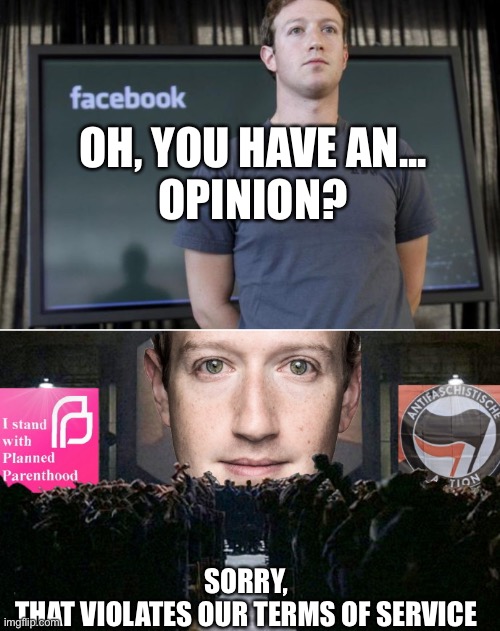
With that out of the way, let’s get back to the main point of this blog post to begin with: Big Tech. My stance on Big Tech has always been a mixed bag. On one hand, I do believe social media companies should have the same private property rights as anyone else. On the other hand, I’m not a fan of Big Tech’s censorship and deplatforming. A great example of recent Big Tech censorship is the recent deplatforming of Russian citizens. Ever since Russia’s invasion of Ukraine, tech companies such as Google(including Youtube), Apple, Microsoft, Twitter, Reddit, Namechamp and many other companies have all been caught either restricting Russian users and content or out right banning it in general. Regardless of how you feel about Russia or Ukraine—you could love either side or hate them entirely. None of that matters within the context of censorship. The Russian government is NOT the Russian people. A Nation-State is not a nation. A state is nothing more than a instiution with a monopoly over the use of force within a given territory. If the Russian government were to collapse tonight— the Russian people would still exist. Demographics are what define nations, not Nation-States. If Russia’s entire population were to be replaced by Chinese people overnight then Russia as a nation would not be the same— even if the government and leaders were left intact from such a scenario. My point being, punishing innocent Russian citizens doesn’t make any sense. Especially since there’s anti-war Russian protests going on during the government’s invasion. Despite this, Tech companies and western governments lump all Russians under the same bus regardless of Russian government support.
How is this not considered xenophobia by the corporate press? When Donald Trump implemented restrictions on Muslim travel during his term, progressive media outlets like the New York Times condemned Trump’s actions. Whenever right-wingers discrimnate against certain demographics, it get slandered as bigotry. But whenever progressive individuals, insitutions and organizations discriminate against demographics they despise they get praised as being on the “right side of history”. These double standards are present in both politics and entertainment. It might be a shock to those who aren’t familiar with how the corporate press operates. But for people like me? This is nothing new. The corporate press has always been weaponizing public opinion to manipulate government policy and the Overton Window. But I won’t be focusing much on mainstream media much in this blog post. How and why the corporate press does this is a topic for another day. For now let’s focus on Big Tech’s censorship and various proposed solutions on how to deal with it.
The Social Conservative Apporach: When you ask a typical social conservative argument they’ll usually bring up anti-trust legislation, abolishing Section 230, and turning social media platforms into “public services” as potential solutions for dealing with Big Tech’s oligarchy. Outside of abolishing Section 230, I oppose the other social conservative “solutions” on limiting Big Tech influence over online discourse. Anti-Trust legislation is generally worthless for reasons mentioned in this video. Turning social media platforms into public ultilities is also a terrible idea since it would neuter private property rights and inspire further progressive restrictions on private platforms in general (sort of like how Texas’ abortion law inspired further California gun regulation). Youtuber Logan Liberty explains why this solution is terrible in this video. Now that I’ve explained why the social conservative approach isn’t the best— it’s about time I offered some actual proper solutions.
My Approach: The first step I would take to limiting Big Tech’s influence over the Internet is to abolish Intellectual Property. A lot of large companies such as Google, Facebook, Microsoft, and Apple rely on legal monopolies such as patents to help them limit market competition. Getting rid of these patents would allow smaller tech startups to use similar technology as Big Tech and potentially even allow for more technological improvement due to the increased competition. For more information on why Intellectual Property should be abolished go here. The second step I would take would be to abolish Section 230. The reason why I oppose Section 230 is because it allows Big Tech enforce their Terms of Service in an inconsistent matter while still claiming to be “open platforms”. My fourth step would be to end the military industrial complex. Big Tech firms like Amazon often abuse the “Business of War” for their own personal gain. By getting rid of government contracts with Tech firms, Silicon Valley won’t be able to profit from the military industrial complex anymore. My fifth step would be banning government subsidies and bailouts for the entire private sector. Companies like Facebook and Google recieve billions of dollars in corporate welfare. Subsidies like this prevent large corporations from going bankrupt, making it nearly impossible for new competitors to gain market share. My fifth and final step to my solution is to become less reliant on Big Tech platforms when possible in favor of alternatives. Tired of Youtube? Use Odysee or Brighteon. Hate Facebook? Use MeWe. Done with Twitter? Use Minds, SkyFeed, or Gab. Dislike Gmail? Use Totanota, Mailfence, or CTemplar. Frustrated with Reddit? Use Saidit or Notabug. I could list other examples of free speech alternatives to Big Tech, but if I did— I’d be here all day. The point is, there are plently of alternatives to Big Tech already. We just need more people to give them a chance.


I’m more close to the social conservative solution, still I don’t want to transform social media into public services instead I like the proposition of the Heritage Party (Founded by David Michael Kurten) to clasify them as publishers if they inquire in censorship practices, but I completely agree we mut use more and encourage Alt-tech depending less of mainstream big tech
LikeLiked by 1 person
Sorry I put the same commentary two times, you can delete one of them
LikeLiked by 1 person